
Ovulation Symptoms: 12 Signs You’re Ovulating (+ Day-by-Day Timeline)
- Ovulation happens once per cycle, typically 12–16 days before your next period, not always “day 14.”
- The most reliable physical signs are cervical mucus changes and a sustained basal body temperature (BBT) rise.
- Many symptoms (mood shifts, mild cramping, breast tenderness) are common but not conclusive on their own.
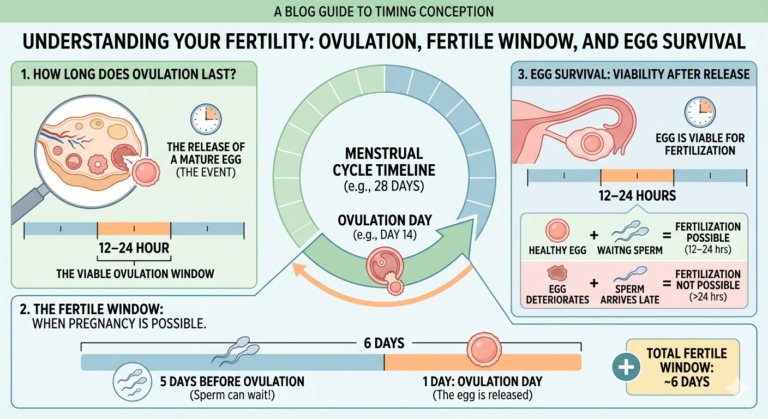
- The fertile window is the six days ending on ovulation day; conception odds are highest in the 2–3 days before ovulation.
- Not everyone notices ovulation symptoms — absence of symptoms doesn’t necessarily mean you aren’t ovulating.
- Combining two or more tracking methods (mucus + BBT + OPK) is far more accurate than relying on one sign alone.
- Persistent absence of any ovulation signs, alongside irregular or missing periods, is worth discussing with a doctor.
- Ovulation Calculator — Estimate your next ovulation date based on your cycle length.
- Period Tracker — Log your cycles to spot patterns in symptoms and timing.
- Fertility Score Quiz — Get a personalized snapshot of your fertility factors.
- Due Date Calculator — Once you know your ovulation date, estimate a due date if you conceive this cycle.
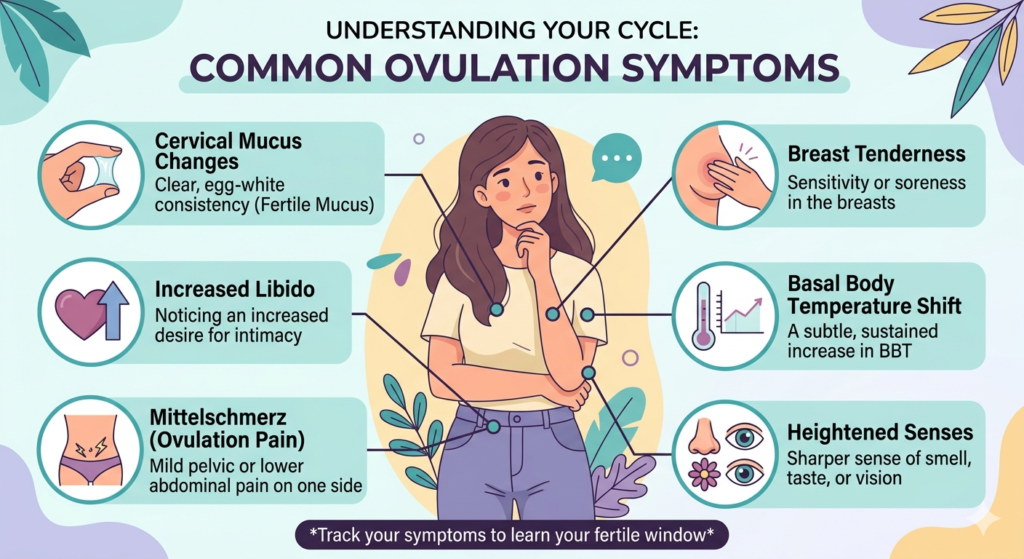
The most common ovulation symptoms are clear, stretchy cervical mucus (like raw egg white), a slight rise in basal body temperature after a dip, one-sided lower abdominal pain (mittelschmerz), breast tenderness, increased sex drive, mild bloating, and a positive ovulation predictor kit (OPK) result from a luteinizing hormone (LH) surge. Ovulation itself occurs about 24–36 hours after the LH surge and typically 12–16 days before your next period.
If you’ve ever wondered whether your body gives you any warning before releasing an egg, the answer is: often, yes — but the signals can be subtle, inconsistent, and easy to miss if you don’t know what to look for. Ovulation symptoms range from a slippery change in cervical mucus to a barely-there twinge on one side of your lower belly, and recognizing them can make a real difference whether you’re trying to conceive, avoiding pregnancy, or simply trying to understand your own cycle better.
This guide walks through all 12 recognized ovulation symptoms, ranks how reliable each one actually is, lays out a day-by-day timeline of your fertile window, and answers the questions people search for most — all grounded in guidance from Mayo Clinic, Cleveland Clinic, ASRM, and peer-reviewed research.
Table of Contents
- What Is Ovulation, Exactly?
- The 12 Signs of Ovulation
- How Reliable Is Each Symptom?
- Your Fertile Window: Day-by-Day Timeline
- How to Track Ovulation Symptoms Accurately
- When Ovulation Symptoms Are Absent or Unusual
- Ovulation Symptoms vs. Early Pregnancy Symptoms
- The Research Behind Ovulation Timing
- Frequently Asked Questions
1. What Is Ovulation, Exactly?
Ovulation is the point in your menstrual cycle when a mature egg is released from one of your ovaries into the fallopian tube, where it can potentially be fertilized. It’s triggered by a surge in luteinizing hormone (LH) from the pituitary gland, which causes the dominant follicle to rupture and release the egg — a process that unfolds over about 24 to 36 hours after the LH surge begins.
For most people with a “textbook” 28-day cycle, ovulation happens around day 14. But cycle length varies widely — anywhere from 21 to 35 days is considered typical — so ovulation timing shifts accordingly. A more accurate rule of thumb is that ovulation tends to occur 12 to 16 days before your next period starts, counting backward rather than forward.
Did You Know? The egg itself is only viable for fertilization for about 12–24 hours after release. After that, it’s reabsorbed by the body. Sperm, on the other hand, can survive in the reproductive tract for up to five days — which is why the fertile window extends well before ovulation day itself.
Want a personalized estimate? Try the Ovulation Calculator to predict your next fertile window based on your own cycle length.
2. The 12 Signs of Ovulation
Not everyone experiences all of these, and that’s completely normal. Here’s what to watch for, symptom by symptom.
Cervical Mucus Changes
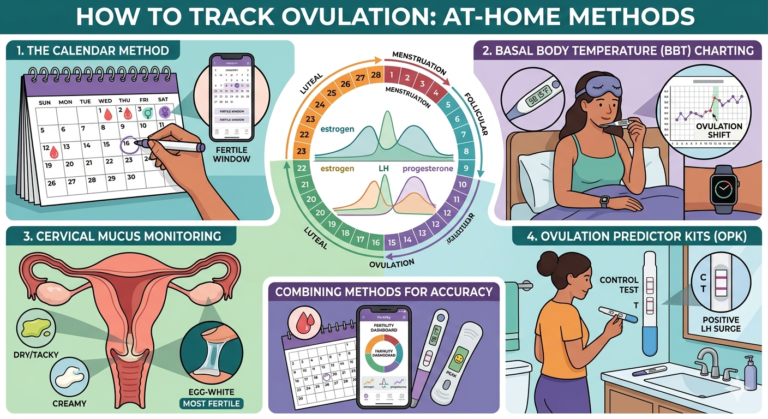
As estrogen rises approaching ovulation, cervical mucus shifts from sticky or absent to clear, stretchy, and slippery — often compared to raw egg white. This texture change makes it easier for sperm to travel through the cervix. It’s widely considered one of the two most reliable physical signs of ovulation, alongside basal body temperature.
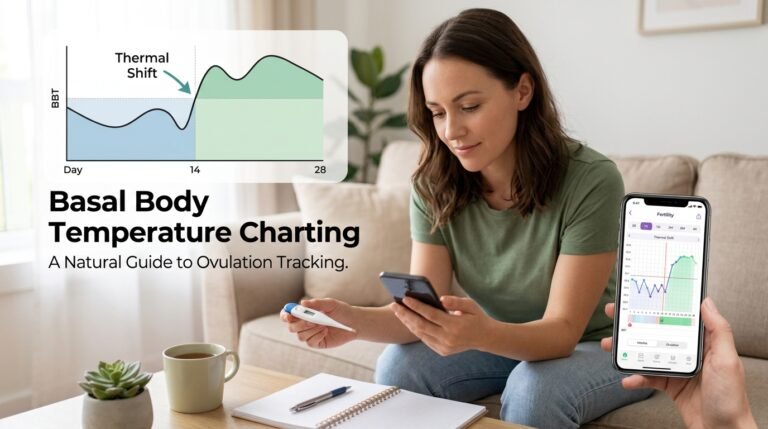
Basal Body Temperature (BBT) Rise
Your basal body temperature — your resting temperature first thing in the morning — rises by roughly 0.4 to 1.0°F (0.2–0.5°C) after ovulation, due to increased progesterone. Because the rise happens after the egg has already been released, BBT confirms ovulation retrospectively rather than predicting it in real time. See our full guide to basal body temperature charting for a step-by-step method.
Expert Tip: Take your temperature at the same time every morning, before getting out of bed, talking, or drinking anything — even small movements can skew the reading. Track it for at least two to three cycles before looking for a pattern.
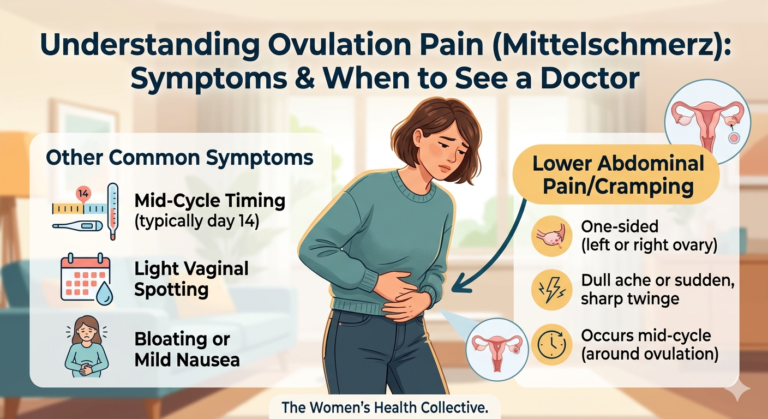
Ovulation Pain (Mittelschmerz)
Some women feel a dull ache or sharp twinge on one side of the lower abdomen around ovulation, known as mittelschmerz (German for “middle pain”). It’s thought to occur as the follicle stretches and releases the egg, sometimes along with a small amount of fluid or blood. It typically lasts anywhere from a few hours to a couple of days. Read more in our dedicated guide: Ovulation Pain (Mittelschmerz): Is It Normal?
Positive Ovulation Predictor Kit (OPK)
OPKs detect the LH surge in urine that precedes ovulation by roughly 24–36 hours. A positive result is one of the most direct hormonal indicators available without a clinical blood test, and it’s widely used alongside mucus and temperature tracking for a fuller picture.
Mild Spotting
Light spotting — sometimes pink or brown — can occur around ovulation due to the brief dip in estrogen just before the egg is released. It’s generally not a cause for concern if it’s light and brief.
Breast Tenderness
Rising estrogen and progesterone around ovulation can cause breast tenderness or sensitivity, similar to premenstrual breast changes but occurring roughly two weeks earlier in the cycle.
Increased Sex Drive
Many women notice a temporary rise in libido around ovulation — a pattern researchers link to hormonal shifts that occur specifically during the fertile window, which some interpret as an evolutionary cue tied to peak fertility.
Heightened Sense of Smell
Some women report a sharper sense of smell or taste sensitivity around ovulation, though this symptom is less consistently documented than mucus or BBT changes.
Mild Bloating
Hormonal fluctuations, particularly the estrogen peak just before ovulation, can cause temporary water retention and bloating.
Cervical Position Changes
Throughout the cycle, the cervix shifts in position, firmness, and openness. Around ovulation, it tends to become higher, softer, and more open — sometimes remembered with the acronym SHOW (Soft, High, Open, Wet). This method requires practice and consistency to track accurately.
Ovulation Headaches
The estrogen surge and subsequent drop around ovulation can trigger headaches or migraines in some women who are hormonally sensitive to these fluctuations.
Increased Energy and Mood Lift
Alongside physical symptoms, some women report a burst of energy or improved mood right around ovulation, likely tied to the same hormonal peak responsible for increased libido.
Common Mistake: Assuming that feeling any single symptom — like mild cramping — confirms ovulation. Isolated symptoms are common throughout the cycle for other reasons (digestion, stress, unrelated hormonal shifts). Reliable confirmation comes from combining multiple signs over time, not one data point.
3. How Reliable Is Each Symptom?
| Symptom | Reliability | Predictive or Confirmatory? |
|---|---|---|
| Cervical mucus (egg-white texture) | High | Predictive |
| Positive OPK (LH surge) | High | Predictive (24–36 hrs ahead) |
| BBT sustained rise | High | Confirmatory (after the fact) |
| Cervical position (SHOW) | Moderate | Predictive |
| Ovulation pain (mittelschmerz) | Moderate | Same-day |
| Breast tenderness | Low–Moderate | Non-specific |
| Increased libido | Low–Moderate | Predictive, but subjective |
| Mild spotting | Low–Moderate | Same-day |
| Bloating | Low | Non-specific |
| Heightened smell/taste | Low | Non-specific |
| Ovulation headaches | Low | Non-specific |
| Increased energy/mood lift | Low | Non-specific |
Pro Insight: For the most accurate real-world tracking, pair a predictive sign (cervical mucus or OPK) with a confirmatory one (BBT). This combination is standard practice in fertility awareness methods and gives you both a heads-up and a confirmation.
4. Your Fertile Window: Day-by-Day Timeline
Research on the timing of intercourse relative to ovulation shows conception odds shift day by day across a six-day fertile window that ends on ovulation day itself.
| Day Relative to Ovulation | Approx. Conception Probability | Typical Symptoms |
|---|---|---|
| 5 days before | ~10% | Mucus starts thinning/increasing |
| 4 days before | ~15% | Mucus becoming clearer |
| 3 days before | ~20% | Egg-white mucus, rising libido |
| 2 days before | ~25–30% | Peak mucus, possible OPK positive |
| 1 day before | ~30–33% (peak) | OPK positive, possible mittelschmerz |
| Ovulation day | ~10–20% | Mittelschmerz, spotting possible |
| 1 day after | Near 0% | BBT rise begins, mucus drying up |
Probabilities are approximate ranges drawn from published fertility research (see Research section below) and vary by individual.
Myth vs. Fact
Myth: You’re most fertile on ovulation day.
Fact: Conception odds peak in the 1–2 days before ovulation, since the egg is only viable for up to 24 hours while sperm can wait in the reproductive tract for days.
Curious where you land in your own cycle right now? The Ovulation Calculator can map this timeline to your specific cycle length.
5. How to Track Ovulation Symptoms Accurately
Quick Checklist for Reliable Tracking:
- Check cervical mucus daily, ideally at the same time
- Take BBT every morning before getting out of bed
- Use OPK strips starting a few days before your expected fertile window
- Log symptoms in a period-tracking app or the Period Tracker
- Track for at least 2–3 full cycles before relying on patterns
- Note any irregular cycles or missing symptoms to discuss with a provider
Combining methods consistently over several cycles gives a far clearer picture than any single symptom in isolation — a point echoed across Mayo Clinic and Cleveland Clinic patient guidance.
6. When Ovulation Symptoms Are Absent or Unusual
It’s normal not to notice every symptom every cycle, and some people rarely notice physical signs at all despite ovulating regularly. However, a pattern of no ovulation signs combined with irregular, absent, or very unpredictable periods can indicate anovulation (cycles where no egg is released), which is associated with conditions like PCOS, thyroid dysfunction, high stress, or significant changes in weight or exercise.
If you go several months without a period, or consistently see no signs of ovulation alongside irregular cycles, it’s worth speaking with a healthcare provider — see NHS guidance on ovulation pain for when to seek help. Learn more about related patterns in our guide to irregular period causes.
7. Ovulation Symptoms vs. Early Pregnancy Symptoms
Because ovulation and very early pregnancy can both cause breast tenderness, mild cramping, and mood changes, it’s easy to confuse the two. The key difference is timing: ovulation symptoms cluster around the middle of your cycle, while early pregnancy symptoms typically appear closer to when your period would be due, roughly 10–14 days later. For a full breakdown, see 12 Early Pregnancy Symptoms Before a Missed Period.
8. The Research Behind Ovulation Timing
A landmark study published in the New England Journal of Medicine tracked 221 women across 625 menstrual cycles using daily hormone testing to pinpoint ovulation, and found that conception occurred almost exclusively within a six-day window ending on the day of ovulation, with daily probabilities ranging from roughly 10% to 33% depending on proximity to ovulation.
The American Society for Reproductive Medicine (ASRM) similarly defines the fertile window, for counseling purposes, as the six-day interval ending on ovulation day, noting that both egg and sperm viability are believed to be highest during that stretch.
Statistics Snapshot:
- Egg viability after ovulation: 12–24 hours
- Sperm viability in the reproductive tract: up to 5 days
- Typical cycle length range considered normal: 21–35 days
- Conception probability on peak fertile days: approximately 30–33%
- Conception probability 5 days before ovulation: approximately 10%
Related FeminaTrack Resources
Calculators:
Related Articles:
- How to Track Ovulation: 5 Methods That Actually Work
- What Is a Fertile Window and How Do You Calculate Yours?
- Ovulation Pain (Mittelschmerz): Is It Normal?
- How Long Does Ovulation Last?
- 12 Early Pregnancy Symptoms Before a Missed Period
- Basal Body Temperature Charting
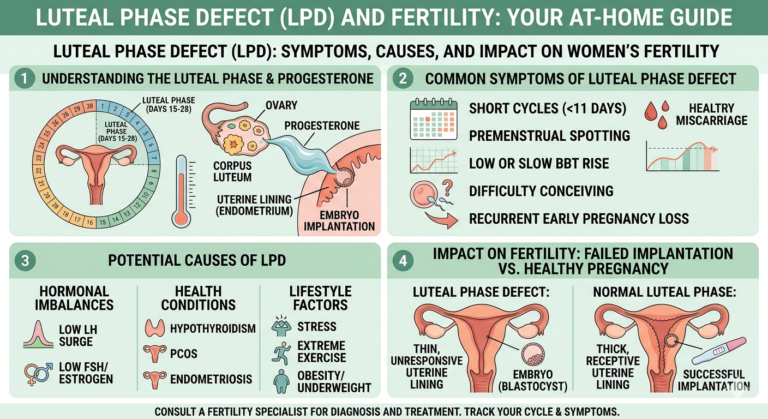
- Luteal Phase Defect: Signs and Causes
Conclusion
Recognizing ovulation symptoms is less about spotting one dramatic sign and more about learning your body’s own pattern over time. Cervical mucus changes and basal body temperature remain the two most trustworthy indicators, and pairing them with an OPK gives the clearest possible picture of your fertile window. Whether you’re trying to conceive, avoid pregnancy, or simply understand your cycle better, consistent tracking — using tools like FeminaTrack’s Ovulation Calculator and Period Tracker — turns subtle signals into genuinely useful information.
This content is for educational purposes only and should not replace professional medical advice, diagnosis, or treatment.
How many days after ovulation can you take a pregnancy test?
Most home pregnancy tests are accurate starting around 12–14 days after ovulation, once implantation has occurred and hCG has built up enough to detect.
Can you feel yourself ovulating?
Some people notice mittelschmerz (one-sided cramping), but many ovulate without any noticeable sensation. Not feeling ovulation doesn’t mean it isn’t happening.
What is the most reliable sign of ovulation?
Cervical mucus changes and a sustained basal body temperature rise are considered the two most reliable physical indicators, especially when tracked together.
How long do ovulation symptoms last?
Individual symptoms like mittelschmerz typically last a few hours to a couple of days; the overall fertile window spans about six days.
Can you ovulate without any symptoms?
Yes. Many women ovulate regularly without noticing any obvious physical signs.
Do ovulation symptoms mean you’re pregnant?
No — ovulation symptoms occur before a possible pregnancy, roughly midway through the cycle, and are caused by the egg release process itself, not by pregnancy.
How soon after ovulation can implantation happen?
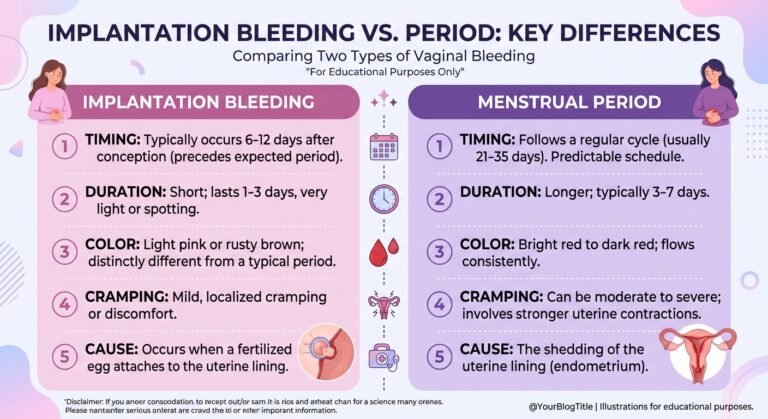
Implantation typically occurs 6–10 days after ovulation, once a fertilized egg has traveled to the uterus.
What does ovulation discharge look like?
Fertile cervical mucus is typically clear, stretchy, and slippery, resembling raw egg white.
Can stress affect ovulation symptoms?
Yes — significant stress can delay or suppress ovulation altogether, which may also change or mask typical symptoms that cycle.
Is it normal to have no ovulation pain?
Yes, most women don’t experience noticeable ovulation pain at all; only a portion of women report mittelschmerz.
How accurate are ovulation predictor kits?
OPKs are generally quite accurate at detecting the LH surge when used correctly and consistently, though results can be affected by conditions like PCOS.
Can you have ovulation symptoms and not actually ovulate?
Yes — some cycles are anovulatory even though hormone fluctuations still produce symptom-like sensations. This is one reason combining multiple tracking methods is more reliable than relying on symptoms alone.
Does basal body temperature predict or confirm ovulation?
BBT confirms ovulation after it has already happened, since the temperature rise follows the progesterone increase that occurs post-ovulation.
What’s the difference between ovulation pain and implantation cramping?
Ovulation pain occurs mid-cycle around egg release; implantation cramping, if it occurs, happens roughly 6–10 days after ovulation and is often accompanied by light spotting.
Should I track ovulation if I’m not trying to conceive?
Many people track ovulation simply to understand their cycle, anticipate PMS, or use fertility awareness methods — it isn’t only useful for those trying to conceive.
2 Comments