
How to Track Ovulation: 5 Methods That Actually Work
Tracking ovulation can feel overwhelming at first — especially when you are bombarded with apps, test strips, temperature charts, and conflicting advice online. But here is the truth: you do not need to use every method at once. You just need to find the one or two that work best for your lifestyle and stick with them consistently. In this guide we are going to walk through the 5 most effective ways to track ovulation at home, how each one works, what it costs, and who it works best for — so you can choose the right method for you and start tracking your cycle with confidence today.
Why Tracking Ovulation Matters
Whether you are trying to conceive, avoiding pregnancy naturally, or simply want to understand your body better, knowing when you ovulate is one of the most useful things you can do for your health.
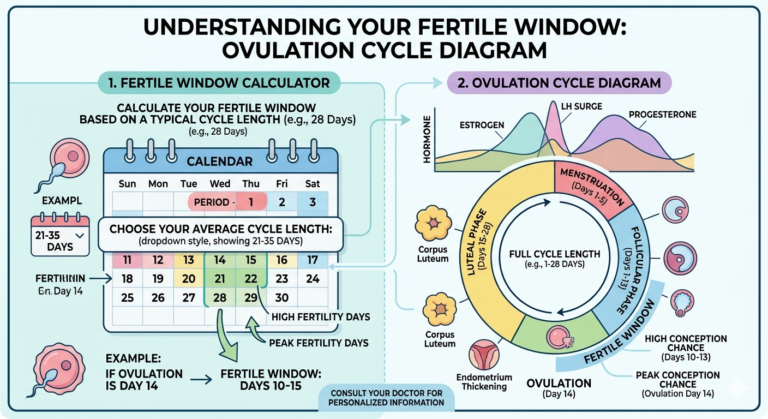
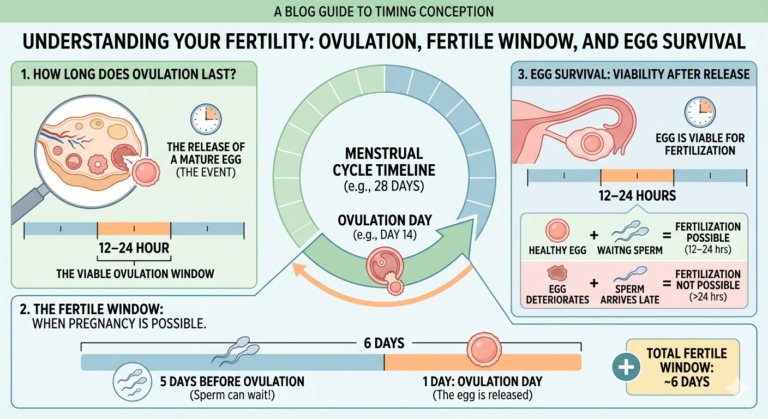
Here is why it matters so much: the fertile window — the days when pregnancy is possible — is only about 6 days long each cycle. Miss that window and you have to wait another full month. But find it consistently and you dramatically increase your chances of conceiving, or understand your cycle well enough to make informed decisions about your reproductive health.
The challenge is that ovulation does not happen at the same time for every woman. A woman with a 28-day cycle ovulates around day 14. A woman with a 32-day cycle ovulates closer to day 18. And even the same woman can ovulate earlier or later depending on stress, illness, travel, or changes in sleep.
That is exactly why tracking matters — and why our Free Ovulation Calculator is a great starting point to estimate your fertile window based on your own cycle length.
Ovulation Predictor Kits (OPKs)
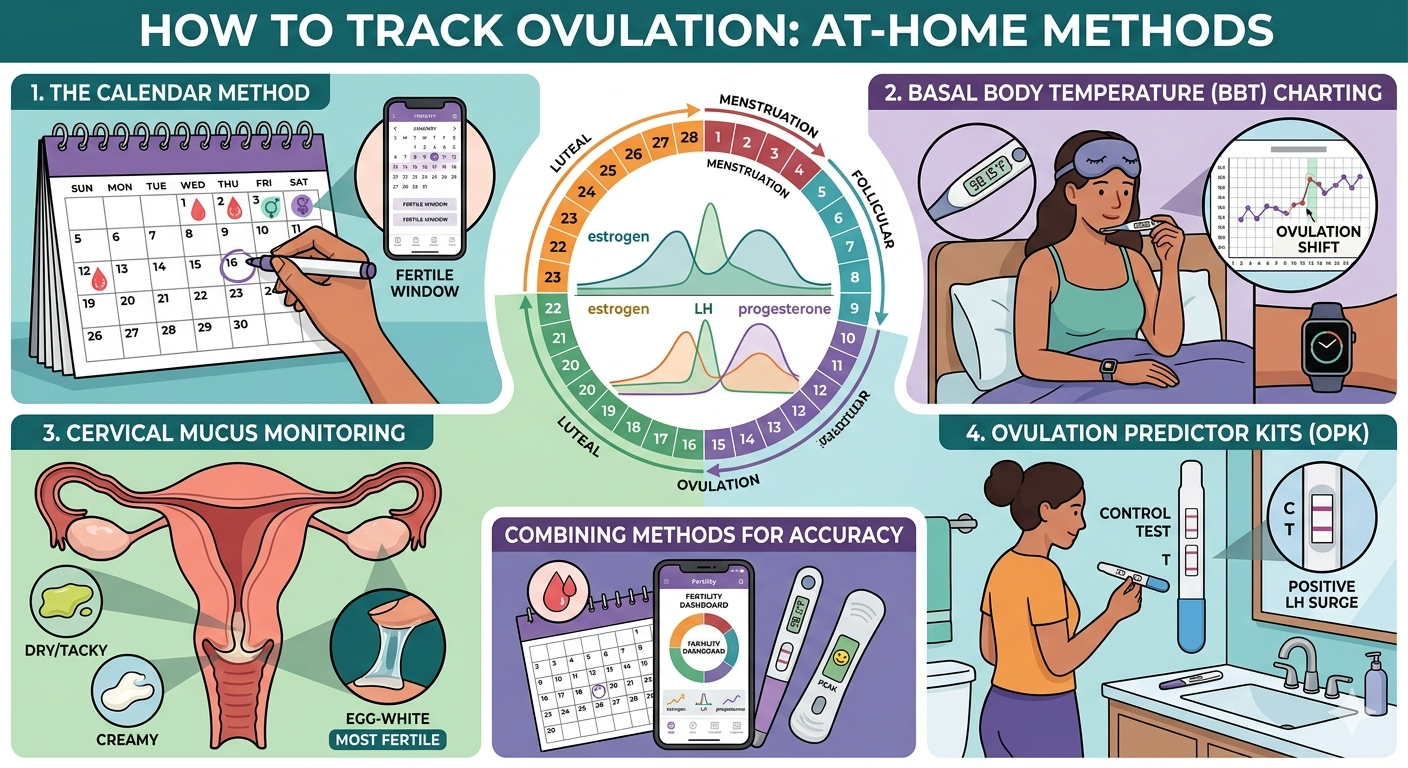
Ovulation predictor kits are urine test strips that detect the surge of luteinizing hormone (LH) that triggers ovulation. When you get a positive result — meaning the test line is as dark as or darker than the control line — ovulation is typically 24 to 36 hours away.
How to Use It
Start testing a few days before your estimated ovulation date. If your cycle is 28 days, start on day 10 or 11. If your cycle is longer, adjust accordingly — you can use our Ovulation Calculator to help figure out when to start.
Test at the same time every day. The best time is between noon and 8pm — morning urine is more concentrated but can sometimes give false positives on OPKs. Avoid drinking large amounts of fluid for 2 hours before testing.
Keep testing until you see a positive result, then have intercourse that day and the following day.
Can Ovulation Predictor Kits Be Wrong?
Yes — OPKs can occasionally give a false positive or false negative. False positives can happen if you have naturally higher baseline LH levels (this is common with PCOS, covered in more detail below) or if you’re using certain fertility medications. False negatives can happen if you miss your actual LH surge because it was brief, or if you’re testing at the wrong time of day. If your OPK results seem inconsistent with other signs (like cervical mucus changes), combining methods rather than relying on OPKs alone gives a more reliable picture.
Best For
Women who want a clear, easy-to-read signal without having to interpret subtle body changes. OPKs are especially helpful if you have regular cycles and want a straightforward advance warning of ovulation.
Cost
Affordable — you can buy a pack of 20 to 50 strips online for under $15. Bulk strip tests are the most economical option.
Method 2: Basal Body Temperature (BBT) Charting
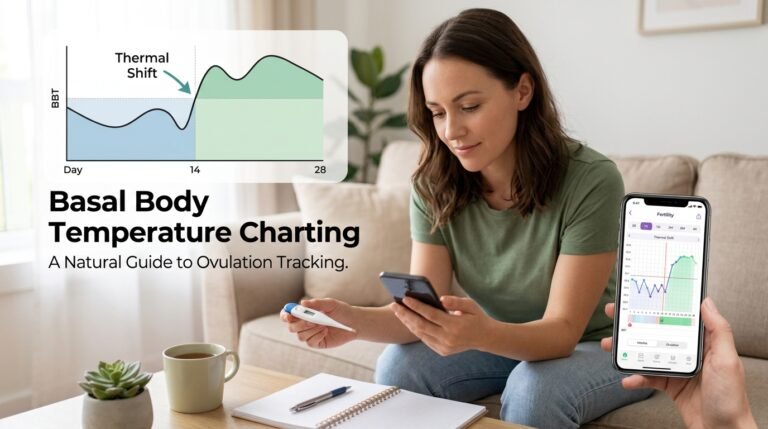
Basal body temperature is your body’s resting temperature — measured first thing in the morning before you get up, talk, or check your phone. After ovulation, the hormone progesterone causes a small but measurable rise of 0.2°F to 0.5°F that stays elevated until your next period.
According to the Cleveland Clinic, BBT charting is one of the most widely used natural fertility awareness methods and can help women identify patterns in their cycle over time.
How to Use It
Buy a basal body thermometer — these are more precise than regular thermometers, measuring to two decimal places. Take your temperature at the same time every morning before getting out of bed, ideally after at least 3 hours of uninterrupted sleep.
Record your temperature in a tracking app or a simple spreadsheet. After 2 to 3 cycles you will be able to see a clear shift — temperatures are lower in the first half of your cycle and rise after ovulation.
Important Note About BBT
BBT tells you that ovulation has already happened — not that it is about to happen. This means BBT charting is most useful for identifying your pattern over several months rather than predicting ovulation in real time within a single cycle. For the best results combine BBT with OPK testing. For a full step-by-step method, see our complete guide to BBT charting.
Best For
Women who want to understand their cycle pattern over time and confirm that ovulation is actually occurring each month. Also useful for women with irregular cycles who want to spot trends.
Cost
A basal thermometer costs between $10 and $20. Many free apps can record and chart your temperatures automatically.
Method 3: Cervical Mucus Monitoring
What It Is
Your cervical mucus changes in consistency and appearance throughout your cycle in response to hormonal shifts. Learning to check and read these changes is completely free, requires no equipment, and gives you real-time information about your fertility.
How to Check and Read Cervical Mucus
Check your discharge every day — either by wiping with toilet paper before urinating or by inserting a clean finger. Here is what each stage looks like:
After your period ends: dry or very little discharge.
Several days before ovulation: sticky, crumbly, or creamy white discharge.
Approaching ovulation: discharge becomes wetter, clearer, and more slippery.
At ovulation: clear, stretchy, slippery mucus that resembles raw egg whites. This is called egg-white cervical mucus (EWCM) and it is your most fertile sign. If you can stretch it an inch or more between your fingers without it breaking, ovulation is very close.
After ovulation: mucus becomes sticky and thick again as progesterone rises.
How Long After Egg-White Cervical Mucus Do You Ovulate?
Egg-white cervical mucus typically appears in the 1 to 3 days leading up to ovulation, making it one of your most useful real-time fertility signs. It’s most fertile-quality right around the day or two before ovulation itself, then tends to dry up again within a day or so afterward as progesterone rises. Because the exact timing varies somewhat between cycles and individuals, it’s most reliable when combined with an OPK or BBT tracking for confirmation.
Best For
Women who want a completely free, no-equipment method. It does take a few months to learn to read the signs accurately, but once you do it becomes second nature.
Cost
Completely free.
Method 4: The Calendar Method
What It Is
The calendar method uses the history of your past cycles to predict when you are likely to ovulate in future cycles. It is based on the principle that ovulation typically occurs 14 days before the start of your next period — regardless of your total cycle length.
How to Use It
Track the start date of your period for at least 3 to 6 months. Then use this formula to estimate your ovulation day:
Your cycle length minus 14 equals your estimated ovulation day.
For example: if your cycle is 30 days long, ovulation likely occurs around day 16. If your cycle is 26 days, ovulation is around day 12.
You can skip the math entirely by using our Free Ovulation Calculator — just enter your last period date and cycle length and it calculates your fertile window instantly.
Limitations of the Calendar Method
The calendar method is the least precise of the five methods because it assumes your cycle length is consistent. Stress, illness, travel, or hormonal changes can shift ovulation by several days. Use it as a rough guide rather than a standalone method. If your cycles are irregular or unpredictable, see the dedicated section below — the calendar method specifically is not a good fit in that situation.
Best For
Women with very regular cycles who want a quick estimate without any testing. Best used alongside another method like OPKs or cervical mucus monitoring for better accuracy.
Cost
Free — you just need a calendar or a period tracking app.
Method 5: Fertility Monitors
What It Is
Fertility monitors are advanced devices that track multiple hormones — typically both LH and estrogen — to identify a wider fertile window than basic OPK strips. Some monitors also track progesterone to confirm ovulation occurred. Popular options include the Clearblue Advanced Fertility Monitor and the Mira Fertility Tracker.
How to Use It
Most fertility monitors use daily urine test sticks that you insert into the device. The monitor stores your hormone data over time and learns your personal cycle, making predictions more accurate with each passing month.
Some newer wearable monitors track hormones through skin sensors — these are worn on your wrist or upper arm and give continuous readings without daily testing.
Best For
Women who want the most accurate at-home tracking available, have been trying to conceive for several months without success, or have irregular cycles that make simpler methods unreliable.
Cost
This is the most expensive option — monitors typically cost between $100 and $200, with ongoing costs for replacement test sticks. However for women who have been TTC for a while the extra accuracy can be well worth the investment.
How to Track Ovulation With Irregular Periods or PCOS
If your cycles are irregular — including if you have PCOS, which commonly causes irregular or absent ovulation — the calendar method will not work reliably, since it depends on a consistent cycle length. Here’s what to use instead.
OPKs with PCOS: OPKs can still be used with PCOS, but results can be harder to interpret. Because PCOS is often associated with naturally elevated baseline LH levels, some women see multiple “false positive” surges before actual ovulation. Testing daily over a longer stretch of the cycle, rather than just a narrow window, and combining OPKs with another method below, gives a clearer picture.
Cervical mucus monitoring works regardless of cycle regularity, since it responds to your actual hormone levels in real time rather than a predicted date — making it one of the more reliable options for irregular cycles.
BBT charting over several months can help identify whether and when ovulation is happening even without a predictable cycle length, though it will take longer to see a clear pattern than it would with regular cycles.
Tracking without a period at all (for example, postpartum, coming off hormonal birth control, or during perimenopause) works the same way — cervical mucus and BBT don’t require a period to be meaningful, since they respond to what’s actually happening hormonally right now, not to a calendar prediction.
If you have irregular or absent periods and are unable to identify a clear ovulation pattern after 2 to 3 months of tracking, it’s worth speaking with your doctor, who can order a progesterone blood test or additional evaluation.
Comparing All 5 Methods Side by Side
Here is a quick summary to help you decide which method — or combination of methods — is right for you:
OPK strips are affordable, easy to use, and give advance notice of ovulation — best for most women starting out.
BBT charting is free (after buying the thermometer) and confirms ovulation occurred — best combined with OPKs.
Cervical mucus monitoring is completely free and works in real time — best for women who want a natural approach, and one of the more reliable options with irregular cycles.
The calendar method is a quick estimate — best as a supporting tool rather than a standalone method, and not recommended if your cycles are irregular.
Fertility monitors are the most accurate — best for women with irregular cycles or those who have been TTC for several months.
How to Get Started Today
If you are just beginning to track your ovulation the simplest and most effective starting point is to combine two methods: OPK strips and cervical mucus monitoring. OPKs give you advance warning while cervical mucus gives you real-time confirmation — together they cover both prediction and detection.
Start by figuring out your estimated ovulation date. Use our Free Ovulation Calculator to get your personalized fertile window based on your last period and cycle length — it takes less than 30 seconds.
From there, buy a pack of OPK test strips, start checking your cervical mucus daily, and track everything in a simple app. Within one to two cycles you will already have a much clearer picture of your body and your fertility. For the complete list of related ovulation signs, see our full guide to ovulation symptoms.
Frequently Asked Questions
How soon before ovulation should I start using OPKs?
Start testing 3 to 4 days before your estimated ovulation date. If your cycle is 28 days, begin on day 10 or 11. If you are unsure when to start, our Ovulation Calculator can give you a personalized start date based on your cycle length.
Can I track ovulation with an irregular cycle?
Yes — but it requires more patience. Cervical mucus monitoring and OPK strips work regardless of cycle length because they respond to your actual hormone levels rather than a predicted date. BBT charting over several months can also help identify patterns even in irregular cycles.
Is it possible to ovulate and not know it?
Absolutely. Many women ovulate without noticing any symptoms at all. The only ways to confirm ovulation are through OPK tests, BBT charting, cervical mucus monitoring, or a progesterone blood test ordered by your doctor.
How do I know if I am not ovulating?
If you track your BBT for 3 or more months and never see a temperature rise, or if your OPK tests never turn positive, it is worth speaking with your doctor. They can order a day-21 progesterone blood test to confirm whether ovulation is occurring.
Does stress affect ovulation?
Yes. High levels of stress can delay or even suppress ovulation by disrupting the hormonal signals your brain sends to your ovaries. This is one of the main reasons ovulation does not always happen on the same day each cycle.
The Bottom Line
Tracking ovulation does not have to be complicated or expensive. The right method for you depends on your lifestyle, your budget, and how much detail you want. For most women starting out, a combination of OPK strips and cervical mucus monitoring gives the best balance of accuracy, affordability, and simplicity. If your cycles are irregular or you have a condition like PCOS, cervical mucus and BBT tend to be more reliable than calendar-based prediction.
The most important thing is to start. Even one or two months of tracking will give you more insight into your cycle than years of guessing.
Use our Free Ovulation Calculator to find your estimated fertile window right now — and take the first step toward understanding your cycle on your own terms.
Medical Disclaimer: This article is for educational purposes only and does not constitute medical advice, diagnosis, or treatment. Always consult your doctor, OB-GYN, or qualified healthcare provider for personal health decisions. Read our full Medical Disclaimer.
4 Comments