
Trying to Conceive for the First Time: A Complete Beginner’s Guide
INTRO
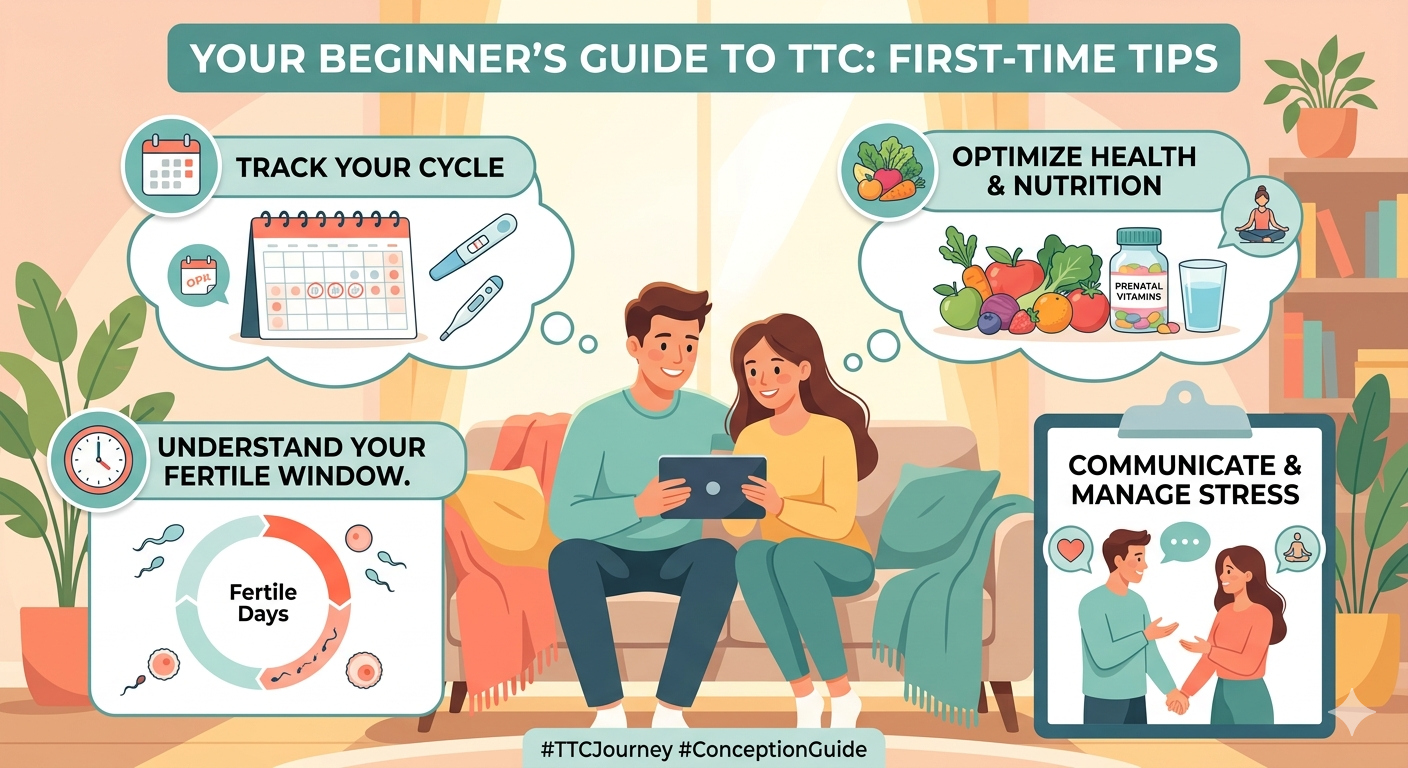
Deciding to try for a baby is one of the most significant decisions of your life (TTC — “trying to conceive” — is the term you’ll see used throughout this guide and across fertility communities.) — and once you have made it the natural next question is what do I actually do now? If you are trying to conceive for the first time the amount of information available online can feel completely overwhelming. Fertile windows, luteal phases, OPK strips, BBT charting, two-week waits — the TTC world has its own language and its own set of tools that can take time to understand. This guide is designed to cut through the noise and give you a clear, practical, step-by-step foundation for your TTC journey — from the basics of how conception works all the way through to what to do if things take longer than expected. Whether you are just starting out or a few months in and looking to be more strategic this is everything you need to know in one place.
Step 1 — Understand How Conception Actually Works
Before you can optimize your chances of conception it helps to understand the biology — because once you understand how conception works the timing recommendations stop feeling arbitrary and start making complete sense.
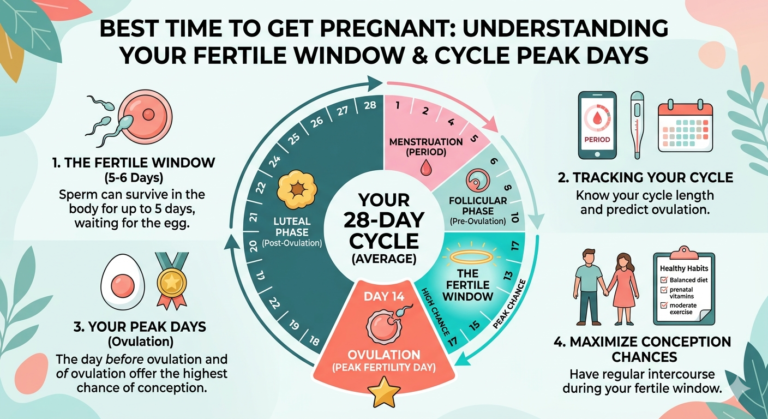
Every month one of your ovaries releases a mature egg in a process called ovulation. This egg travels into the fallopian tube where it can be fertilized by sperm. The egg is only viable — capable of being fertilized — for 12 to 24 hours after it is released. After that it dissolves and pregnancy is no longer possible until the following cycle.
Sperm on the other hand can survive inside the female reproductive tract for up to 5 days when fertile cervical mucus is present. This creates a fertile window of approximately 6 days — the 5 days before ovulation and ovulation day itself — during which intercourse can result in pregnancy.
The most important takeaway from this biology is simple: you can only get pregnant during those 6 days. Outside of that window pregnancy is not biologically possible no matter how frequently you have intercourse. This is why identifying your fertile window accurately is the single most impactful thing you can do when trying to conceive.
Use our Free Ovulation Calculator to find your estimated fertile window based on your last period date and average cycle length — it is the fastest way to get your starting point.
Step 2 — Start Tracking Your Cycle
The foundation of an effective TTC strategy is knowing your cycle. This means knowing when your period starts, how long your cycle typically is, and when you are likely to ovulate. You cannot optimize timing without this data.
If you have not been tracking your cycle start now — even if you have already been trying for a few months. Use our Free Period Tracker to log the start date of every period and any symptoms you notice. After 2 to 3 months of tracking you will have a clear picture of your average cycle length and be able to estimate your ovulation date with much greater accuracy.
Here is what to track every cycle.
Period start date — the first day of full bleeding. This is cycle day 1 and the starting point for all cycle calculations.
Period duration — how many days your period lasts and how heavy the flow is. Changes in period length or flow can be early indicators of hormonal shifts worth noting.
Cycle length — count from the first day of one period to the first day of the next. Track this for at least 3 cycles to find your true average.
Ovulation signs — any mid-cycle changes in cervical mucus, ovulation pain, or positive OPK results. These help you identify your actual ovulation date rather than relying solely on a calculated estimate.
Step 3 — Learn to Identify Your Fertile Window
Once you know your average cycle length you can estimate when your fertile window falls. The standard formula is to subtract 14 from your cycle length to find your estimated ovulation day. Your fertile window spans from 5 days before that day through ovulation day itself.
But estimates are just a starting point. For the most accurate identification of your fertile window use real-time tracking methods alongside your calculated estimate.
There are three main real-time tracking methods worth knowing. OPK strips detect the LH surge that triggers ovulation, giving you 24 to 36 hours of advance notice. Cervical mucus monitoring is free and gives you a real-time signal — clear, stretchy egg-white mucus means your fertile window is open. BBT charting confirms after the fact that ovulation occurred, which helps you learn your personal pattern over time.
For a complete step-by-step breakdown of how to use each method — including how to combine them for the best accuracy — see our complete guide to tracking ovulation.
Step 4 — Time Intercourse to Your Fertile Window
Now that you know when your fertile window is you need to make sure you are having intercourse during it — specifically in the days leading up to ovulation rather than after it.
The research-backed recommendation is to have intercourse every 1 to 2 days throughout your fertile window — starting from approximately 5 days before your estimated ovulation date and continuing through ovulation day.
When your OPK turns positive have intercourse that day and the following day to make sure you cover your two highest-probability days.
You do not need to have intercourse multiple times per day — daily or every other day is sufficient and optimal for most couples. You also do not need to restrict intercourse exclusively to the fertile window but covering those specific days is what gives you the best conception probability each cycle.
For a personalized estimate of your fertile window and your peak days use our Free Ovulation Calculator.
Step 5 — Optimize Your Preconception Health
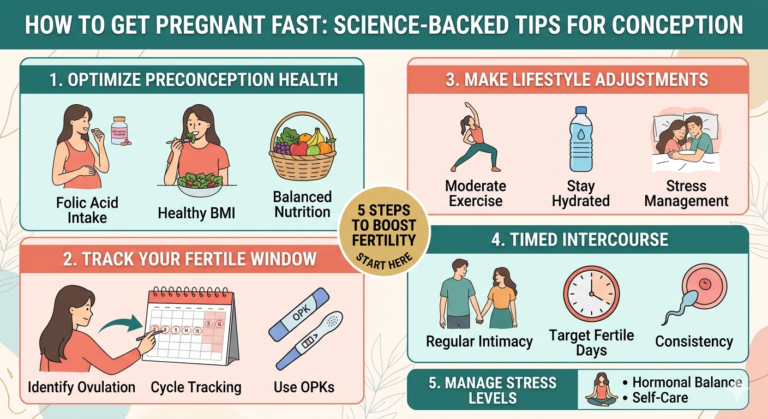
Your body is the environment your baby will grow in for nine months — and the health of that environment starts before conception even occurs. Several preconception health steps have clear evidence behind them for improving both conception chances and pregnancy outcomes.
Start a Prenatal Vitamin
Start taking a prenatal vitamin now — before you conceive. The most critical nutrient is folic acid at 400 to 800 micrograms daily which prevents neural tube defects that develop in the first 4 weeks of pregnancy — often before you even know you are pregnant. A complete prenatal vitamin also provides iron, calcium, vitamin D, iodine, and DHA which support your health and early fetal development.
See our complete guide to prenatal vitamins for what to look for and when to start.
Eat a Fertility-Supportive Diet
A diet rich in whole foods, healthy fats, fiber, and key micronutrients supports hormonal balance and reproductive health. Focus on vegetables particularly dark leafy greens, fruits, whole grains, legumes, nuts and seeds, and lean protein including fatty fish rich in omega-3s. Reduce ultra-processed foods, refined sugar, and excessive caffeine — all of which can negatively affect hormonal balance and egg quality over time.
Maintain a Healthy Weight
Both underweight and overweight status can disrupt ovulation and reduce fertility. Achieving and maintaining a weight that supports regular menstrual cycles is one of the most impactful preconception health steps you can take.
Limit Alcohol and Caffeine
Many fertility specialists recommend avoiding alcohol entirely when trying to conceive — particularly in the two-week wait after ovulation when early embryo development is occurring. Caffeine intake above 200 to 300mg per day has been associated with slightly increased time to conception in some studies. Limiting caffeine to one to two moderate cups per day is a sensible precaution.
Stop Smoking
Smoking significantly reduces fertility and egg quality and increases miscarriage risk. If you smoke quitting before trying to conceive is one of the most important things you can do for your fertility and your future baby’s health.
Review Your Medications
Some medications are not safe to take during pregnancy — and some affect fertility. Speak with your doctor about any prescription or over-the-counter medications you are currently taking so they can advise whether any need to be changed or discontinued before you conceive.
Step 6 — Understand the Two-Week Wait
The two-week wait (TWW) is the stretch of days between ovulation and when your period is due — during which you are waiting to find out whether conception occurred. It is universally described as the most emotionally challenging part of the TTC journey.
Here is what is happening in your body during the two-week wait. If fertilization occurred the embryo travels from the fallopian tube to the uterus over the first 3 to 5 days. Between 6 and 12 days after ovulation implantation occurs — the embryo burrows into the uterine lining. Once implantation occurs hCG production begins and levels start to rise. At approximately 12 to 14 days past ovulation hCG levels may be high enough to detect on a pregnancy test.
During the two-week wait it is completely normal to notice symptoms — but it is also important to know that the symptoms of early pregnancy and the symptoms of normal PMS are almost identical because both are driven by progesterone. This means symptom-spotting during the TWW is notoriously unreliable. The only way to know whether you are pregnant is a pregnancy test.
If you do get a positive result use our Free Due Date Calculator immediately to find your estimated due date — and our Free hCG Calculator to understand your early pregnancy hormone levels.
Step 7 — Take Care of Your Mental Health During TTC
This step is just as important as the physical ones — and it is the one most commonly left out of TTC guides.
Trying to conceive — particularly when it takes longer than expected — can be emotionally exhausting. The monthly cycle of hope and disappointment takes a real toll on mental health and relationships. Research published by the American Society for Reproductive Medicine consistently shows that the psychological stress of fertility challenges is comparable to the stress of serious illness — and that chronic stress can itself affect cycle regularity and fertility.
Practical steps to protect your mental health during TTC include setting limits around how much time you spend reading TTC forums and symptom-spotting each day. Maintain your social life and hobbies outside of TTC — having an identity beyond trying to conceive is essential. Talk openly with your partner about the emotional demands of the process. Seek support from a therapist or counselor if TTC stress is significantly affecting your daily life. And give yourself permission to feel whatever you feel — including grief when a cycle does not work out — without judgment.
Step 8 — Know the Common TTC Terms
The TTC community has developed an extensive shorthand vocabulary that can feel completely foreign when you first encounter it. Here is a quick glossary of the terms you will encounter most often.
AF — Aunt Flo. Your period.
BD — Baby dancing. Intercourse during the fertile window.
BFN — Big fat negative. A negative pregnancy test.
BFP — Big fat positive. A positive pregnancy test.
CD — Cycle day. The number of days since your period started. CD1 is the first day of your period.
DPO — Days past ovulation. How many days since you ovulated.
EWCM — Egg-white cervical mucus. The clear stretchy discharge that indicates peak fertility.
LP — Luteal phase. The second half of your cycle from ovulation to your next period.
LPD — Luteal phase defect. A condition where the luteal phase is too short or progesterone is insufficient.
OPK — Ovulation predictor kit. Urine test strips that detect the LH surge before ovulation.
TTC — Trying to conceive.
TWW — Two-week wait. The waiting period between ovulation and when your period is due.
Step 9 — Know When to Seek Medical Help
One of the most important pieces of advice for anyone starting their TTC journey is understanding when to stop trying to figure it out alone and seek expert support. Many couples wait far too long — and many treatable issues go unidentified for months or years as a result.
The standard guidelines are clear. Under 35 years old seek a fertility evaluation after 12 months of well-timed unprotected intercourse without conception. Between 35 and 39 years old seek evaluation after 6 months. 40 years or older seek evaluation after 3 months or even before starting to try.
Seek help sooner regardless of age if you have irregular or absent periods which may indicate ovulation problems. Also seek help sooner if you have a known reproductive health condition like PCOS or endometriosis, if you have had two or more miscarriages, if you have a history of pelvic infections or sexually transmitted infections, or if your partner has any known fertility concerns.
Seeing a doctor is not giving up — it is being proactive. A fertility evaluation typically starts with simple blood tests and a semen analysis and can identify many common and treatable issues quickly.
A Month-by-Month TTC Action Plan for Beginners
Here is a practical action plan for your first three months of TTC to give you a clear sense of what to focus on at each stage.
Month 1
Start your prenatal vitamin. Log your period start date in our Free Period Tracker. Use our Free Ovulation Calculator to estimate your fertile window. Buy a pack of OPK strips and start testing a few days before your estimated ovulation date. Have intercourse every 1 to 2 days throughout your fertile window. After ovulation wait until your period is due before testing — testing too early leads to unnecessary false negatives and emotional distress.
Month 2
Log your cycle data from month 1. Refine your ovulation estimate based on when your OPK turned positive last cycle. Add cervical mucus monitoring if you have not already. Continue the same fertile window coverage approach. If your period arrives take note of any patterns — was your cycle the same length as usual, did you notice EWCM at the expected time, did your OPK positive occur when expected.
Month 3
By month 3 you have meaningful cycle data. You should have a good sense of your average cycle length, typical ovulation timing, and fertile window. Use this data to refine your timing further. If you are not yet pregnant continue with the same approach through month 6 before seeking a fertility evaluation if under 35.
Frequently Asked Questions
How long does it take most couples to get pregnant?
For couples having well-timed regular unprotected intercourse approximately 30% conceive in the first month, about 60% by 6 months, and around 85% by 12 months. If you have not conceived after 12 months (or 6 months if you are 35 or older) a fertility evaluation is recommended.
Can you get pregnant on your period?
It’s unlikely but not impossible, especially with shorter cycles. Sperm can survive up to 5 days inside the body, so if you have a short cycle (around 21–24 days) and ovulate earlier than average, sperm from period-time intercourse could theoretically still be present when ovulation occurs. It’s a low-probability scenario, not a reliable form of either contraception or conception timing.
Can you ovulate while pregnant?
No — once pregnancy occurs, rising hormones (particularly progesterone and hCG) suppress further ovulation for the duration of the pregnancy. Any pelvic sensations that feel similar to ovulation pain during pregnancy are typically round ligament pain instead.
Why am I not getting pregnant?
For most couples, it simply takes time — see the statistics above on how long conception typically takes. If you’ve been trying for the guideline length of time in Step 9 without success, or have any of the risk factors listed there, that’s the signal to seek a fertility evaluation rather than continuing to wait it out on your own.
Should I stop using birth control before trying to conceive?
Yes — but the timing depends on what type of contraception you have been using. The combined oral contraceptive pill typically allows fertility to return within 1 to 3 months of stopping though it can take longer. The contraceptive injection (Depo-Provera) can take 6 to 12 months or longer for fertility to return. Barrier methods like condoms have no effect on fertility — fertility returns immediately upon stopping. Discuss the timing of stopping contraception with your doctor if you have concerns.
What is the best age to try to conceive?
From a purely biological standpoint female fertility is highest in the mid-20s and begins to decline gradually from the late 20s, more noticeably from the mid-30s, and more significantly after 37 to 38. However the best time to try to conceive is when you feel personally, emotionally, financially, and practically ready — the biological considerations are just one factor in a much larger life decision.
Can I get pregnant while breastfeeding?
Yes — breastfeeding suppresses ovulation but does not prevent it reliably enough to serve as contraception. Many women ovulate before their first postpartum period returns meaning they can conceive without realizing their fertility has returned. If you are breastfeeding and want to avoid pregnancy use a reliable contraceptive method. If you are breastfeeding and trying to conceive tracking for signs of ovulation returning — particularly through OPK testing and cervical mucus monitoring — is important.
Does the position you have sex in affect conception chances?
There is no scientific evidence that any particular sexual position significantly improves conception chances. Sperm are deposited near the cervix regardless of position and are capable of swimming to the egg from there. Some fertility specialists suggest lying down for 10 to 15 minutes after intercourse but the evidence for this is inconclusive. Focus on timing rather than position.
What should I do differently in the two-week wait?
During the two-week wait continue living your normal life as much as possible. Avoid testing before 12 to 14 DPO — early testing leads to unnecessary false negatives and emotional distress. Moderate exercise, good nutrition, adequate sleep, and stress management are all beneficial. Avoid alcohol in the two-week wait since if implantation has occurred early embryo development is already underway. And try — however hard it is — to limit symptom-spotting since early pregnancy and PMS symptoms are indistinguishable.
The Bottom Line
Starting your TTC journey well-informed gives you a significant advantage. The couples who conceive most quickly are typically not the luckiest — they are the ones who understand their cycles, identify their fertile window accurately, optimize their health before conception, and seek help promptly when something is not going as expected.
Your most important first step is to start tracking your cycle and identifying your fertile window. Use our Free Ovulation Calculator to find your estimated fertile window today and our Free Period Tracker to begin logging your cycles consistently from this cycle onward.
When you get that positive test — and you will — use our Free Due Date Calculator to find your estimated due date and our Free hCG Calculator to understand your early pregnancy hormone levels. We are rooting for you every step of the way.
Medical Disclaimer: This article is for educational purposes only and does not constitute medical advice, diagnosis, or treatment. Always consult your doctor or a reproductive specialist for personalized fertility and preconception advice. Read our full Medical Disclaimer.
One Comment