

Implantation Bleeding: What It Looks Like and How to Tell It Apart From Your Period

INTRO
Few things create more confusion during the two-week wait than unexpected spotting. Is it your period arriving early, or could it be implantation bleeding — one of the earliest possible signs of pregnancy? The two can look deceptively similar at a glance, and Googling at midnight rarely makes things clearer. The truth is, once you understand what’s happening biologically and know exactly what signs to look for, the differences become much easier to spot. In this article we’ll walk through what implantation bleeding actually is, what it looks like in detail, how it compares to a normal period symptom by symptom, what other early signs often accompany it, and exactly when you should take a pregnancy test for the most reliable result.
What Is Implantation Bleeding?
Implantation bleeding occurs when a fertilized egg burrows into the uterine lining — a process called implantation — typically 6 to 12 days after ovulation. As the embryo attaches itself to the lining, it can disrupt small surface blood vessels, causing a small amount of blood to escape into the vaginal canal. This shows up as light spotting, often much lighter than anything you’d associate with a period.
According to the Cleveland Clinic, implantation bleeding is one of the earliest physical signs of pregnancy, though it is often mistaken for an early or unusually light period because the timing falls so close to when a period would normally be expected.
Not every pregnant woman experiences this. Estimates suggest only about 25% to 30% of pregnant women notice implantation bleeding at all, so its absence is completely normal too and does not mean anything is wrong with a pregnancy that has occurred without visible spotting.
Use our Free Ovulation Calculator to estimate when implantation might occur in your cycle based on your ovulation date — this gives you a window to watch for in the days following.
What Does Implantation Bleeding Look Like?
Because so much rides on getting this right, it helps to break down exactly what implantation bleeding looks like across several specific characteristics.
Color
Implantation bleeding is typically light pink or light brown — almost never the bright red or darker red commonly seen during a normal period. The brownish tint often comes from older blood that has taken slightly longer to leave the body, which is part of why it looks different from fresh menstrual flow.
Flow
The flow is very light — often just a smear visible when wiping, or a few small spots on underwear. It is never heavy enough to require a regular pad, and it typically does not require more than a panty liner if anything at all.
Duration
Implantation bleeding usually lasts anywhere from a few hours to about 2 days. This is dramatically shorter than the typical 4 to 7 day duration of a period, and it often stops and starts intermittently rather than flowing continuously.
Pattern
Unlike a period, which typically starts light and builds to a heavier flow before tapering off again, implantation bleeding does not follow this escalating pattern. It tends to stay light and sporadic throughout, sometimes appearing only once and then disappearing entirely.
Implantation Bleeding vs Period — A Detailed Comparison
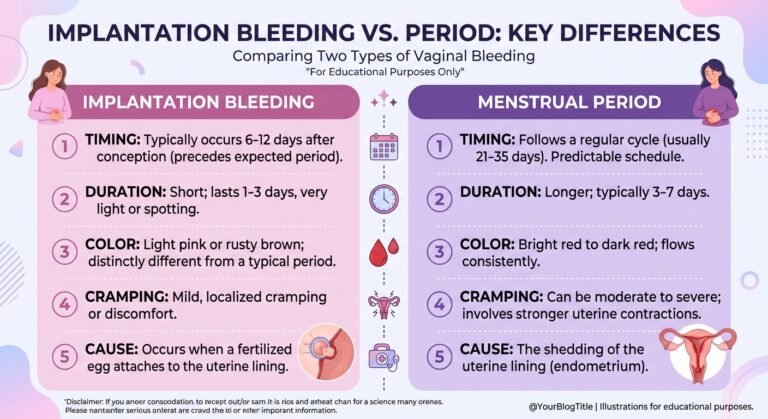
Side by side, several clear distinctions emerge that can help you tell the two apart with more confidence.
Timing: Implantation bleeding occurs 6 to 12 days after ovulation, which is before your period would normally be due. A period arrives on your expected cycle day, roughly 14 days after ovulation for most women with an average luteal phase.
If your period feels unusually late rather than early, see our guide on how many days late is still considered normal.
Color: Implantation bleeding tends to be light pink or brown. Period blood is usually a brighter or darker red, especially on the first heavier days.
Clots: Implantation bleeding rarely if ever contains clots. Period blood often does contain small clots, particularly during the heaviest days of flow.
Cramping: Implantation cramping, when present, is typically mild, brief, and localized to the center of the lower abdomen. Period cramps are often more rhythmic, can radiate to the lower back, and tend to be more intense as the period progresses.
Flow progression: A period typically increases in flow over the first day or two before gradually decreasing. Implantation bleeding stays consistently light throughout and does not escalate.
Track your cycle with our Free Period Tracker so you know exactly when your period is due and can spot anything unusual that falls outside your expected pattern before that date arrives.
Other Early Symptoms That Often Accompany Implantation
Implantation bleeding rarely occurs entirely on its own. Around the same time, many women notice other very early pregnancy signs that can help build a clearer overall picture.
Mild cramping that feels different from typical period cramps — often described as a brief twinge rather than a wave-like ache.
Breast tenderness that feels more pronounced than usual, caused by rising hormone levels.
Fatigue that seems to come on suddenly and feels disproportionate to your activity level.
Mild bloating, caused by rising progesterone relaxing the digestive tract. For the complete picture, see our guide to early pregnancy symptoms before a missed period.
None of these symptoms alone confirm pregnancy, but noticing several together alongside light spotting can be a meaningful pattern worth paying attention to.
When Should You Take a Pregnancy Test?
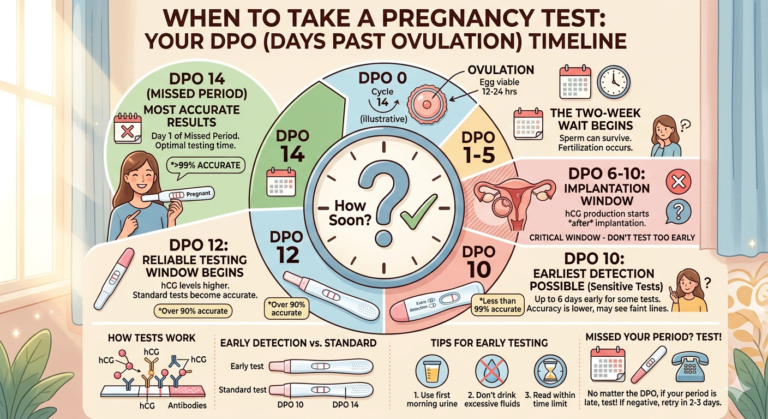
If you notice spotting around 9 to 12 days past ovulation, the most reliable approach is to wait until your period is officially late before testing. Testing too early — before hCG has had time to rise to a detectable level — significantly increases the risk of a false negative, which can be unnecessarily stressful.
For a complete breakdown of testing timelines, see our guide on exactly how soon you can test after ovulation.
If you do choose to test early, use first morning urine and a sensitive early-detection test, then repeat the test 2 to 3 days later if you get a negative result and your period still hasn’t arrived. Use our Free Due Date Calculator to calculate your estimated due date right away if you get a positive result.
When to See a Doctor
Most implantation bleeding requires no medical attention at all. However, contact your doctor if spotting is heavy enough to require a regular pad, if it’s accompanied by severe pain, if it continues for more than a few days, or if you have a positive pregnancy test alongside bleeding — particularly if there is one-sided pelvic pain, as this combination can occasionally indicate a complication that needs prompt evaluation.
Frequently Asked Questions
How many days after implantation bleeding can I test?
Wait 2 to 3 days after spotting stops, or until your period is officially late, for the most reliable test result. Testing immediately after spotting begins is often too early for hCG to be reliably detected.
Can implantation bleeding be heavy?
True implantation bleeding is typically very light. If bleeding is heavy enough to need a regular pad, it is more likely your period, or in rare cases something that warrants a call to your doctor.
Does everyone get implantation bleeding?
No — only about a quarter to a third of pregnant women notice it. Its absence doesn’t mean anything is wrong with the pregnancy; many completely healthy pregnancies have no visible implantation bleeding at all.
Can implantation bleeding come with cramps?
Yes, mild cramping is common and normal alongside implantation spotting. It typically feels brief and mild compared to period cramps.
Can implantation bleeding happen more than once?
It is usually a single brief episode, though some women report it appearing intermittently over a day or two before stopping entirely.
The Bottom Line
Implantation bleeding is light, brief, and occurs before your period is due — typically pink or brown rather than red, without clots, and without the escalating flow pattern of a normal period. But because the signs can overlap, the only way to know for certain is a pregnancy test taken at the right time. Use our Free Ovulation Calculator to track your cycle and know exactly when to expect what, and our Free Period Tracker to log your cycle history for easy comparison.
Medical Disclaimer: This article is for educational purposes only and does not constitute medical advice, diagnosis, or treatment. Always consult your doctor for personal health decisions. Read our full Medical Disclaimer.


2 Comments