
How Many Days Late Can a Period Be Before It Is Considered Missed?
INTRO
A late period is one of the most anxiety, how many days late is normal for period?-inducing experiences in a woman’s reproductive life — whether you are hoping it means pregnancy or hoping it does not. But before you spiral into worry it is worth understanding what late actually means, because the answer is more nuanced than most people realize. Your menstrual cycle is not a precise clockwork mechanism. It is a living hormonal process influenced by dozens of factors — stress, sleep, diet, travel, illness, and more. In this article we are going to answer the question clearly and completely: how many days late is normal for a period, when does late become missed, what are the most common causes of a late period, and exactly what you should do depending on your situation.
For the complete picture, see our full guide to causes of irregular periods.
What Is a Normal Menstrual Cycle?
Before we talk about late periods it helps to establish what normal looks like. A typical menstrual cycle lasts anywhere from 21 to 35 days — measured from the first day of one period to the first day of the next. The average is 28 days but this varies significantly from woman to woman and even from cycle to cycle in the same woman.
This variation is important to understand because a period that seems late based on a 28-day assumption might actually be perfectly on time for a woman whose natural cycle is 32 or 35 days.
Track your personal cycle length consistently with our Free Period Tracker so you know your own average — rather than comparing yourself to a textbook number that may not apply to you.
How Many Days Late Is Normal?
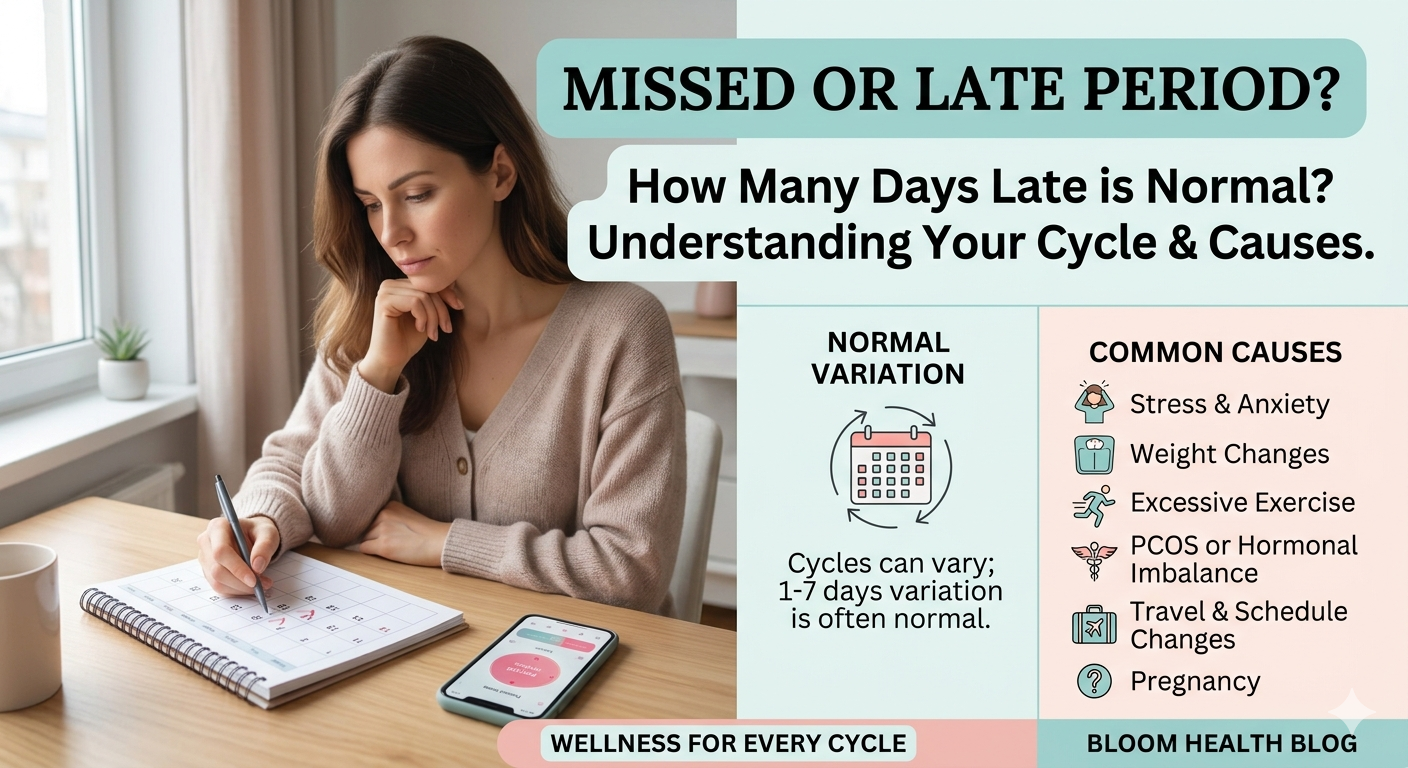
Here is the straightforward answer most women are looking for: a period that arrives up to 7 days later than expected is generally considered within the range of normal variation for most women with regular cycles.
Cycles naturally fluctuate by a few days from month to month. Stress, a change in sleep patterns, illness, travel, or a shift in exercise routine can all push ovulation — and therefore your period — a few days later than usual. A period that is 1, 2, 3, or even 5 days late with no other symptoms is almost always nothing to worry about.
A period that is more than 7 days late warrants attention — either taking a pregnancy test if that is a possibility, or monitoring the situation and contacting your doctor if it does not arrive within the next week.
A period that is more than 35 days from the start of your last period — regardless of your usual cycle length — is generally considered late enough to investigate, even for women with naturally longer cycles.
When Is a Period Considered Missed?
A missed period is technically defined as a period that does not arrive at all within a full cycle length. Most healthcare providers consider a period missed when it is more than 5 to 7 days late for women with regular cycles.
Missing 3 or more consecutive periods — called amenorrhea — is a more significant concern that warrants a thorough medical evaluation regardless of whether pregnancy has been ruled out.
According to the Mayo Clinic, secondary amenorrhea — the absence of periods for 3 or more months in a woman who previously had regular cycles — can be caused by a wide range of conditions from pregnancy and stress to hormonal disorders and structural problems.
The First Thing to Do When Your Period Is Late
If your period is late and there is any chance you could be pregnant — meaning you have had unprotected intercourse in the past month — the very first thing to do is take a pregnancy test. This should always be step one before investigating any other cause.
Modern home pregnancy tests are highly accurate from the first day of a missed period and some can detect pregnancy even a few days before. A positive test is clear and actionable. A negative test on day 1 of a missed period should be repeated 3 to 5 days later if your period still has not arrived — it is possible you ovulated later than expected and hCG levels may not yet be high enough to detect.
If you get a positive pregnancy test use our Free Due Date Calculator to calculate your estimated due date right away — and our Free hCG Calculator to understand what hormone levels to expect in early pregnancy.
Common Causes of a Late Period (That Are Not Pregnancy)
If your pregnancy test is negative and your period is still late there are many common and typically benign reasons this can happen.
Stress
Stress is the single most common non-pregnancy cause of a late period. When you are under significant physical or emotional stress your body produces elevated cortisol which suppresses GnRH — the hormone that triggers ovulation. Delayed ovulation means a delayed period because the luteal phase begins only after ovulation occurs.
The stress does not have to be dramatic or obvious. A busy work period, exam season, relationship difficulties, a move, a bereavement, or even the stress of worrying about a late period can be enough to shift ovulation timing.
What to do: if stress is the likely cause focus on stress reduction — adequate sleep, moderate exercise, time with people who support you, and addressing the underlying stressor where possible. Your period will typically arrive within a few weeks once the stress is managed.
Illness
Any significant illness — a bad flu, a serious infection, or a period of high fever — can temporarily disrupt the hormonal signaling that drives ovulation. Because the period follows ovulation by approximately 14 days, an illness that delays ovulation by a week will delay your period by the same amount.
What to do: this type of delay is temporary and self-resolving. Your cycle should return to normal in the following month once your body has recovered.
Significant Weight Changes
Both rapid weight loss and significant weight gain can disrupt the hormonal balance needed for regular ovulation. When body fat drops too low the hypothalamus reduces hormone production to suppress reproduction — causing periods to become infrequent or stop entirely. When body fat increases significantly the resulting hormonal imbalances can also disrupt cycle timing.
What to do: if a significant weight change has coincided with your late period this is the likely cause. Gradual restoration of a healthy body weight for your frame typically resolves the issue within a few cycles.
Excessive Exercise
Very high levels of physical training — particularly when combined with a caloric deficit — can suppress reproductive hormones and delay or prevent ovulation. This is especially common in women who have recently and dramatically increased their exercise intensity.
What to do: reduce training volume, ensure you are eating enough to support your activity level, and build in adequate rest days. Most women see their cycles normalize within 1 to 2 months.
Travel and Time Zone Changes
Travel — particularly across multiple time zones — disrupts your circadian rhythm and can temporarily affect the hormonal signaling that drives your cycle. Jet lag affects melatonin and cortisol levels in ways that can delay ovulation by several days.
What to do: this is a temporary disruption that typically resolves within one to two cycles as your body adjusts back to its normal rhythm.
Hormonal Birth Control Changes
Starting, stopping, or changing hormonal contraception can significantly disrupt your cycle timing. Women who have recently stopped the pill, patch, or ring may experience delayed periods for 1 to 3 months — and sometimes longer — as their natural hormonal cycle re-establishes itself. This is sometimes called post-pill amenorrhea.
What to do: if you have recently stopped hormonal contraception give your body at least 3 months to re-establish a natural cycle. If your period has not returned within 3 months of stopping birth control see your doctor.
Thyroid Disorder
Both an underactive thyroid (hypothyroidism) and an overactive thyroid (hyperthyroidism) can disrupt the menstrual cycle — causing periods to be late, irregular, heavier, lighter, or absent. Thyroid disorders are extremely common in women and are frequently underdiagnosed.
What to do: ask your doctor for a thyroid function blood test including TSH, free T3, and free T4. Thyroid disorders are very treatable once identified.
Polycystic Ovary Syndrome (PCOS)
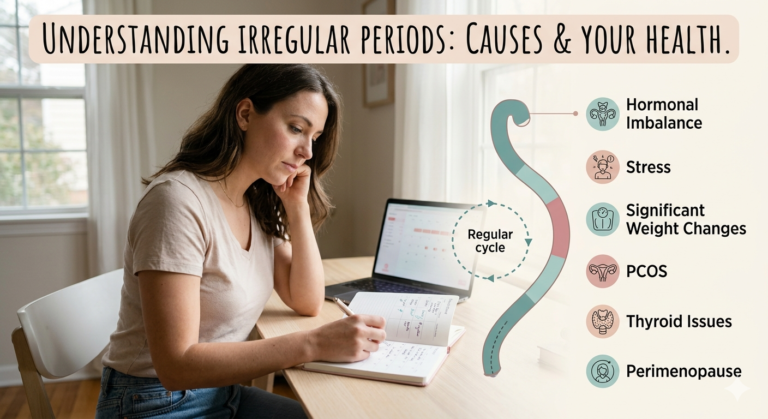
PCOS is one of the most common hormonal conditions affecting women of reproductive age and is a leading cause of irregular and absent periods. Women with PCOS often have cycles that are significantly longer than average — 35 to 90 days or more — or periods that are completely unpredictable.
What to do: if you have other symptoms of PCOS alongside irregular periods — such as acne, excess facial or body hair, difficulty losing weight, or skin darkening — speak with your doctor about testing for PCOS.
Perimenopause
If you are in your late 30s or 40s and your periods are becoming increasingly irregular or delayed perimenopause may be a contributing factor. During the perimenopausal transition hormonal fluctuations cause cycles to become less predictable.
What to do: speak with your doctor about hormone level testing to assess whether perimenopause is contributing. There are effective management options available for perimenopausal symptoms.
Day-by-Day Guide — What to Do When Your Period Is Late
Here is a practical timeline to follow when your period does not arrive on time.
1 to 3 Days Late
This is within the completely normal range of cycle variation for most women. No action needed yet. Continue with your normal routine. If you have had unprotected intercourse you can take a pregnancy test now — though waiting until day 5 to 7 late gives a more reliable result.
4 to 7 Days Late
Still within the normal variation range for many women but worth paying attention to. Take a pregnancy test if there is any possibility of pregnancy. Reflect on whether any of the common causes — stress, illness, travel, exercise changes — might apply to this cycle.
7 to 14 Days Late
Take a pregnancy test if you have not already done so. If negative repeat it in 3 to 5 days. Start tracking any additional symptoms — unusual fatigue, pelvic pain, discharge changes. Consider whether an underlying hormonal issue might be at play if this is a recurring pattern.
More Than 2 Weeks Late
Take a pregnancy test if you have not. If negative make an appointment with your doctor — particularly if this is unusual for you or if your period does not arrive within the next week. A blood test can detect pregnancy even when a urine test gives a negative result and can also check your hormone levels for other causes.
3 or More Missed Periods
See your doctor without delay. Missing 3 or more consecutive periods — called secondary amenorrhea — requires investigation to identify the cause. Use our Free Period Tracker to bring a complete record of your cycle history to your appointment.
Signs Your Late Period Might Be Pregnancy
If your period is late and you are wondering whether pregnancy might be the reason these are the most common early signs to look for alongside a late period.
Breast tenderness or swelling — often one of the earliest physical signs of pregnancy, caused by rising progesterone and hCG levels.
Nausea — pregnancy-related nausea can begin as early as 2 to 4 weeks after conception, before many women even realize they are pregnant.
Fatigue — profound tiredness in early pregnancy is caused by rising progesterone levels and is often one of the first symptoms women notice.
Light spotting or implantation bleeding — a small amount of pink or brown spotting around the time your period was expected can sometimes be implantation bleeding rather than the start of your period.
Frequent urination — increased urination can begin very early in pregnancy as blood volume increases and the kidneys work harder.
Food aversions or heightened sense of smell — hormonal changes in early pregnancy often cause sensitivity to smells and sudden food aversions.
The only way to confirm pregnancy is a pregnancy test. If positive use our Free Due Date Calculator to find your estimated due date and our Free hCG Calculator to understand your early pregnancy hormone levels.
Missed Period, Negative Pregnancy Test — What’s Going On?
This is one of the most common and most confusing situations: your period is late, sometimes by a week or two, and your pregnancy test keeps coming back negative. Here’s what’s actually going on, and when a negative result truly rules out pregnancy versus when it’s worth testing again.
Why You Might Get a Negative Test With a Missed Period
You tested too early relative to ovulation. If you ovulated later than you assumed — which is common even in cycles that are usually predictable — your body may not have produced enough hCG yet to trigger a positive result, even though your period “should” have arrived by your usual calendar.
Diluted urine. Drinking a lot of fluids before testing can dilute the concentration of hCG in your urine enough to cause a false negative, especially with a lower-sensitivity test. Testing with first-morning urine, when hCG is most concentrated, gives the most reliable result.
Testing or timing error. Not waiting the full time specified on the test, using an expired test, or misreading a faint line can all lead to an inaccurate negative.
Your period is late for a non-pregnancy reason. This is actually the most common explanation of all — see the full list of non-pregnancy causes above (stress, thyroid issues, PCOS, weight changes, and others). A late period with a negative test is often simply one of these, not a testing problem at all.
An anovulatory cycle. Occasionally your body doesn’t ovulate at all in a given cycle. Without ovulation, there’s no luteal phase countdown to a period — so rather than being “late,” that cycle may simply not produce a period on the usual schedule.
What to Do If You’re 2 Weeks Late With a Negative Test
If your period is around 2 weeks late and you’ve already tested negative, here’s a sensible next-step sequence:
- Retest with first-morning urine if you haven’t already — this is the most concentrated sample of the day.
- Wait 2 to 3 more days and test again if your period still hasn’t arrived, since hCG rises quickly day to day in early pregnancy.
- Consider a blood test through your doctor — blood tests are more sensitive than home urine tests and can detect pregnancy slightly earlier or confirm a negative with more confidence.
- If two or more home tests are negative and your period still doesn’t arrive within another week, it’s reasonable to shift your focus to the non-pregnancy causes covered earlier in this article, and to check in with your doctor if it continues.
Could I Still Be Pregnant After Multiple Negative Tests?
It’s understandably worrying, but repeatedly negative home tests taken correctly and at appropriate intervals are genuinely reliable — modern tests are about 99% accurate when used on or after the day of a missed period. A blood test at your doctor’s office is the most definitive way to fully rule pregnancy out if you want additional certainty. If your period still hasn’t arrived after that, working through the non-pregnancy causes above with your doctor is the right next step.
When to See a Doctor About a Late Period
Contact your doctor if any of the following apply.
Your period is more than 2 weeks late and pregnancy has been ruled out.
You have missed 3 or more consecutive periods.
Your late period is accompanied by severe pelvic pain, heavy bleeding when it does arrive, or unusual discharge.
You have a positive pregnancy test and one-sided pelvic pain — this could indicate an ectopic pregnancy and requires immediate medical attention.
Your periods have become consistently irregular over the past several months without an obvious lifestyle-related cause.
You are trying to conceive and your cycles are irregular or unpredictable.
Frequently Asked Questions
Can a period be late without being pregnant?
Absolutely — and this is very common. Stress, illness, weight changes, travel, changes in exercise habits, thyroid issues, and PCOS are all frequent non-pregnancy causes of a late period. A late period does not automatically mean pregnancy — but a pregnancy test is always the first step to rule it in or out.
Can you have a period and still be pregnant?
True menstruation — where the uterine lining sheds — does not occur during pregnancy. However some pregnant women experience light bleeding or spotting in early pregnancy that can be mistaken for a light period. This can be implantation bleeding, a subchorionic hemorrhage, or cervical sensitivity. If you have had a light or unusual period and suspect you might be pregnant take a test.
How accurate are home pregnancy tests?
When used correctly and after a missed period home pregnancy tests are 99% accurate. They detect the pregnancy hormone hCG in urine. Testing too early — before a missed period — can give a false negative because hCG levels may not yet be high enough to detect. If you get a negative result but your period still does not arrive repeat the test in 3 to 5 days.
Why do I have a missed period but a negative pregnancy test?
The most common reasons are testing too early relative to actual ovulation, diluted urine, or — most often — a non-pregnancy cause of the late period itself, like stress, thyroid issues, or PCOS. See the full breakdown above for what to do next depending on how late your period is.
Can stress delay a period by 2 weeks?
Yes — significant stress can delay ovulation by 1 to 2 weeks or even longer, which delays the period by the same amount since the luteal phase begins after ovulation. In extreme cases of chronic stress periods can stop entirely for months. This is a real and well-documented physiological response to stress — not something you are imagining.
Is it normal for periods to be late in your 40s?
Yes — cycle irregularity including late or missed periods becomes increasingly common as women approach perimenopause, which typically begins in the mid to late 40s. However significant changes in cycle regularity in your 40s are still worth discussing with your doctor to confirm the cause and discuss management options if symptoms are affecting your quality of life.
Should I track my cycle if my periods are irregular?
Absolutely — in fact tracking is even more important when your cycle is irregular. Use our Free Period Tracker to log every period start date, length, and any symptoms. Over 3 to 6 months patterns often emerge even in seemingly irregular cycles and the data is invaluable for your doctor.
The Bottom Line
A period that is up to 7 days late is generally within the normal range of cycle variation for most women. Beyond 7 days late it is worth investigating — starting with a pregnancy test if that is relevant, then considering common lifestyle-related causes, and seeing your doctor if your period is more than 2 weeks late or if you have missed 3 or more periods in a row.
The most powerful tool you have for understanding your cycle is consistent tracking. Use our Free Period Tracker to log every cycle in detail — so you always know your personal average cycle length and can identify when something is genuinely out of the ordinary for you rather than just different from a textbook norm.
And if your late period turns out to be good news use our Free Due Date Calculator to find out when your baby is due — and our Free Ovulation Calculator to understand your cycle for future reference.
Medical Disclaimer: This article is for educational purposes only and does not constitute medical advice, diagnosis, or treatment. Always consult your doctor or OB-GYN if you have concerns about a late or missed period. Read our full Medical Disclaimer.


2 Comments