How Soon Can You Take a Pregnancy Test After Ovulation?
INTRO
How soon can you take a pregnancy test? If you are in the two-week wait — that agonizing stretch of days between ovulation and your expected period — the question of when you can take a pregnancy test is probably consuming more mental energy than you would like to admit. You want to test. You are trying to wait. You are Googling at 11pm to find out whether testing at 8 days past ovulation could possibly give you an accurate result. We hear you — and we are going to give you the clearest, most complete answer to that question possible. In this article we are going to explain exactly what happens in your body after ovulation that makes early testing possible or not, what DPO means, when different types of tests can reliably detect pregnancy, and how to get the most accurate result whenever you decide to test.
What Happens After Ovulation That Makes a Pregnancy Test Work?
To understand when a pregnancy test can work you first need to understand what the test is actually detecting — and when that substance appears in your body after ovulation.
After ovulation if a sperm fertilizes the egg the resulting embryo travels down the fallopian tube over the next 3 to 4 days. It then reaches the uterus and spends another 2 to 3 days floating in the uterine cavity before beginning the process of implantation — burrowing into the uterine lining.
Implantation typically occurs between 6 and 12 days after ovulation with the most common timing being 8 to 10 days past ovulation (DPO). Before implantation no pregnancy hormone is being produced and no test — however sensitive — can detect a pregnancy.
Once implantation occurs the cells that will become the placenta begin producing hCG — human chorionic gonadotropin. hCG enters the bloodstream first and then spills over into urine. hCG levels roughly double every 48 to 72 hours in a healthy early pregnancy — which means levels rise from undetectable to detectable over a span of several days after implantation.
Use our Free hCG Calculator to understand what hCG levels are normal at different stages of early pregnancy — and our Free Ovulation Calculator to make sure you know exactly when you ovulated so you can calculate your DPO accurately.
What Does DPO Mean?
DPO stands for days past ovulation. It is the standard way the TTC (trying to conceive) community tracks the two-week wait — counting days from confirmed or estimated ovulation rather than from the last menstrual period.
DPO is more precise than counting from your period because the length of the follicular phase — the first half of your cycle — varies significantly between women and cycles. The luteal phase — the second half after ovulation — is much more consistent, typically lasting 12 to 16 days. This makes DPO a more reliable reference point for when to expect implantation, pregnancy symptoms, and a reliable test result.
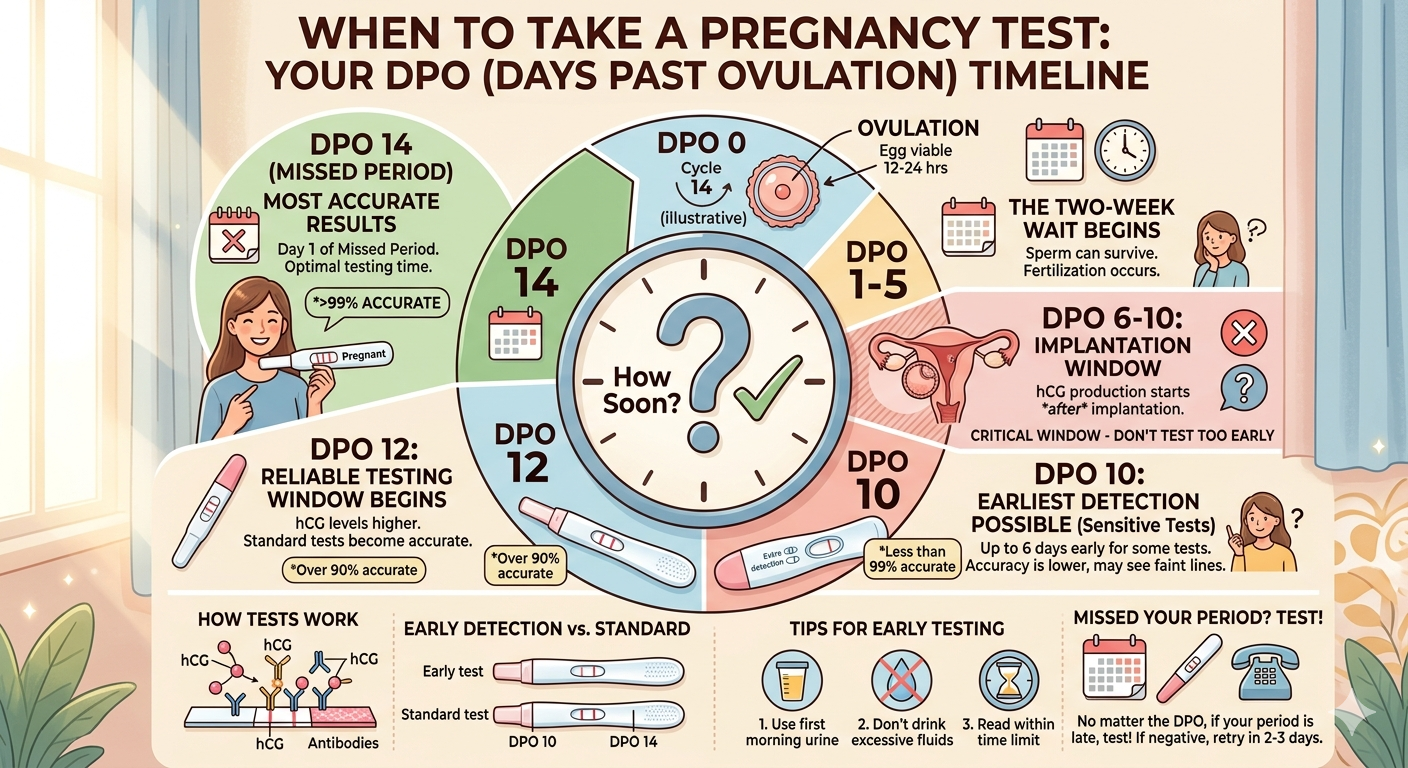
Here is a quick DPO timeline for reference in a typical cycle:
0 DPO — ovulation occurs. Egg is released and viable for 12 to 24 hours.
1 to 5 DPO — fertilized egg travels through the fallopian tube. No hCG production yet.
6 to 12 DPO — implantation window. Most implantations occur between 8 and 10 DPO.
8 to 10 DPO — implantation most commonly occurs. hCG production begins.
10 to 12 DPO — hCG levels begin rising in the blood.
12 to 14 DPO — hCG may begin to appear in urine at detectable levels for sensitive tests.
14 DPO — approximate date of missed period for women with a 28-day cycle. Standard tests reliably positive if pregnant.
The Earliest You Can Possibly Test — and What to Expect
Here is the straightforward breakdown of what different tests can detect at different DPO stages.
Before 10 DPO
Testing before 10 DPO is almost always too early for a reliable result. Even if implantation has occurred hCG levels are so low that virtually no test — including the most sensitive ones available — can reliably detect them. The chance of a false negative at this stage is extremely high.
If you test before 10 DPO and get a negative result it means almost nothing — it simply means you tested too early. Do not interpret an early negative as confirmation that you are not pregnant.
10 to 11 DPO
Some highly sensitive early detection tests — those that can detect hCG at 6 to 10 mIU/mL — may be able to detect a pregnancy at 10 to 11 DPO if implantation occurred on the earlier end of the window (around 6 to 8 DPO) and hCG has had time to rise to a detectable level.
However the chance of a false negative is still significant at this stage — particularly if implantation occurred later (10 to 12 DPO) or if your urine is dilute from drinking lots of fluids.
A positive result at 10 to 11 DPO is meaningful and reliable. A negative result at this stage still does not rule out pregnancy.
12 to 13 DPO
At 12 to 13 DPO early detection tests are more likely to give a reliable positive if you are pregnant. However even at this stage late implantation can mean hCG levels are not yet high enough for some tests to detect.
If you test at 12 to 13 DPO and get a negative result repeat the test 2 days later if your period has not arrived — particularly if you are using a less sensitive test.
14 DPO — First Day of Missed Period
This is the gold standard testing time. At 14 DPO — the approximate first day of a missed period for women with a 28-day cycle — the vast majority of standard home pregnancy tests are sensitive enough to detect pregnancy reliably if implantation has occurred and hCG has had time to rise.
A positive result at 14 DPO on a standard test is highly reliable. A negative result at 14 DPO makes pregnancy less likely — though if your period does not arrive in the next few days repeat the test as late ovulation may have shifted your expected period date.
After a Missed Period
Testing after your period is late gives the most reliable results regardless of which test you use. At this stage even basic pregnancy tests — those detecting hCG at 20 to 25 mIU/mL — are highly accurate. The longer you wait past your missed period the more definitive the result.
Which Pregnancy Tests Detect Pregnancy Earliest?
Not all home pregnancy tests are equally sensitive. The key difference between early detection tests and standard tests is the threshold — the minimum hCG level they can detect.
Ultra-Sensitive Early Detection Tests (6 to 10 mIU/mL)
These tests can theoretically detect pregnancy earlier than standard tests — sometimes as early as 10 to 12 DPO in women who implant early and produce hCG quickly. The most commonly recommended ultra-sensitive tests include PREGMATE strips, Wondfo strips, and the FIRST RESPONSE Early Result (FRER) test.
FRER is one of the most widely trusted early detection tests and is specifically marketed as detecting pregnancy 6 days before a missed period — though reliable results are much more likely from 4 to 5 days before a missed period onward.
Standard Sensitivity Tests (20 to 25 mIU/mL)
These are the most common drugstore tests — brands like Clearblue and store-brand tests. They are highly accurate from the first day of a missed period onward but are less likely to give a reliable positive before that point.
Digital Tests
Digital tests display the result as words — Pregnant or Not Pregnant — which eliminates the anxiety of interpreting line darkness. However digital tests are typically less sensitive than line tests because they require a higher hCG concentration to display a positive result. They are best used after a missed period rather than for early testing.
Tips for Getting the Most Accurate Early Pregnancy Test Result
If you are going to test early — or even at the time of your missed period — these tips will give you the most reliable result possible.
Use First Morning Urine
First morning urine is more concentrated than urine collected later in the day — meaning hCG is present at a higher concentration making it easier for a test to detect. This is particularly important when testing early. If you test in the afternoon or after drinking a lot of fluids you may get a false negative even when hCG is present in your urine.
Do Not Test Too Early
We know — easier said than done. But testing before 12 DPO significantly increases your chance of a false negative which can be emotionally devastating when you are hoping for a positive. If you can hold off until 12 to 14 DPO you will get a far more meaningful result.
Read the Test at the Right Time
Read results within the time window specified in the test instructions — usually 3 to 5 minutes. Reading results after 10 minutes can cause evaporation lines — faint lines caused by urine drying on the test rather than by hCG — which can be mistaken for a positive result.
Check the Expiry Date
Expired pregnancy tests can give inaccurate results. Always check the expiry date before using a test — particularly if you bought a multi-pack months ago.
Repeat a Negative
If you get a negative result but your period does not arrive in the next 2 to 3 days repeat the test. If you are pregnant hCG levels will have risen significantly in those 2 to 3 days making the result much clearer.
Understanding a Faint Positive Line
One of the most anxiety-producing experiences in the two-week wait is seeing a faint line on a pregnancy test and not knowing what it means. Here is the clear answer: any line — however faint — that appears within the reading window of a pregnancy test and has color (even the palest pink) is a positive result.
A faint line means hCG is present in your urine. It is present in a lower concentration — which is entirely expected when testing early. It does not mean something is wrong with the pregnancy. It means you tested early and hCG levels are still rising.
If you see a faint positive line wait 48 hours and test again with first morning urine. The line should be noticeably darker as hCG doubles. A line that is not getting darker over 48 to 72 hours is worth discussing with your doctor.
False Negatives — Why They Happen and What to Do
A false negative is when you are pregnant but the test shows negative. False negatives are far more common than false positives and almost always occur for one of the following reasons.
Testing too early — before hCG has risen to a detectable level in your urine. This is the most common cause.
Dilute urine — testing after drinking large amounts of fluids reduces the concentration of hCG in your urine below the test’s detection threshold.
Testing too late in the day — morning urine contains the most concentrated hCG.
Using a less sensitive test — standard tests require higher hCG levels than early detection tests.
Late implantation — if implantation occurred later than average (10 to 12 DPO rather than 6 to 8 DPO) hCG levels may not yet be detectable at what you thought was 12 to 14 DPO.
What to do: if you get a negative result but feel pregnant or your period does not arrive wait 2 to 3 days and retest with first morning urine and a sensitive test. If the second test is also negative and your period still does not arrive contact your doctor for a blood test which can detect hCG at much lower levels than a urine test.
What Happens After a Positive Test?
If you get a positive pregnancy test the next steps are straightforward.
Calculate your due date — use our Free Due Date Calculator to find your estimated due date based on your last period date. This is one of the first things your OB-GYN will ask for.
Check your hCG levels — use our Free hCG Calculator to see what levels are normal for your week of pregnancy if your doctor orders blood work.
Call your OB-GYN or midwife — schedule your first prenatal appointment for between 8 and 10 weeks of pregnancy. If you have a history of pregnancy complications or ectopic pregnancy your doctor may want to see you sooner.
Start or continue a prenatal vitamin — ensure it contains at least 400 to 800mcg of folic acid, DHA, iron, and iodine.
Avoid alcohol, smoking, raw fish, deli meats, and unnecessary medications until you have spoken with your healthcare provider about what is safe in pregnancy.
Frequently Asked Questions
Can I test at 7 DPO?
Testing at 7 DPO is almost certainly too early to get a reliable result. Implantation has typically not yet occurred at 7 DPO — or if it has hCG production has only just begun and levels are far too low for any test to detect. A negative at 7 DPO means nothing. Save your tests for 12 DPO or later for a result that is actually meaningful.
Is 10 DPO too early to test?
10 DPO is on the early side but not impossibly early for a sensitive test. Women who implanted early (6 to 8 DPO) and are using an ultra-sensitive test (6 to 10 mIU/mL threshold) may get a faint positive at 10 DPO. However false negatives are still common at this stage. A negative at 10 DPO does not rule out pregnancy — test again at 12 to 14 DPO.
What is the most accurate time to take a pregnancy test?
The most accurate time is the first day of a missed period or later, using first morning urine, with a test that has not expired. At this point even standard sensitivity tests are highly accurate — [99% or more when used correctly according to the FDA].
Can I get a positive at 14 DPO and then a negative the next day?
A true positive followed by a true negative is extremely rare and would require a dramatic unexplained drop in hCG. More likely explanations include an evaporation line being mistaken for a positive on the first test, testing with dilute urine on the second test, or using tests of different sensitivities. If you are unsure get a blood test from your doctor for a definitive answer.
How many DPO is a missed period?
For women with a typical 14-day luteal phase a missed period occurs at approximately 14 to 15 DPO. If your luteal phase is shorter — for example 12 days — your period would be missed at 12 to 13 DPO. If your luteal phase is longer — 16 days — your period is not actually late until 16 to 17 DPO. Knowing your luteal phase length makes this calculation more accurate. Use our Free Ovulation Calculator to estimate your ovulation date and luteal phase length.
Does a darker line mean a healthier pregnancy?
Not necessarily. Line darkness reflects the concentration of hCG in your urine at the time of testing — which is affected by how dilute your urine is, how early you are testing, and the sensitivity of the specific test. A faint line on a sensitive early detection test can represent a higher actual hCG level than a dark line on a standard test. Do not compare line darkness between different test brands.
The Bottom Line
The earliest you can get a reliable positive pregnancy test is approximately 12 DPO — and only with a highly sensitive early detection test and concentrated first morning urine. For the most reliable result wait until the first day of your missed period at 14 DPO or later.
A negative result before 12 DPO means almost nothing — it is simply too early. A negative result at 14 DPO makes pregnancy less likely but should be repeated if your period does not arrive within a few days. Any line — however faint — within the reading window on a pregnancy test is a positive.
Know your ovulation date to make DPO counting accurate — use our Free Ovulation Calculator to find your estimated ovulation date based on your cycle length. And when you get that positive result use our Free Due Date Calculator to find out when your baby is expected.
Medical Disclaimer: This article is for educational purposes only and does not constitute medical advice, diagnosis, or treatment. Always consult your doctor if you have concerns about pregnancy test results or early pregnancy. Read our full Medical Disclaimer.