
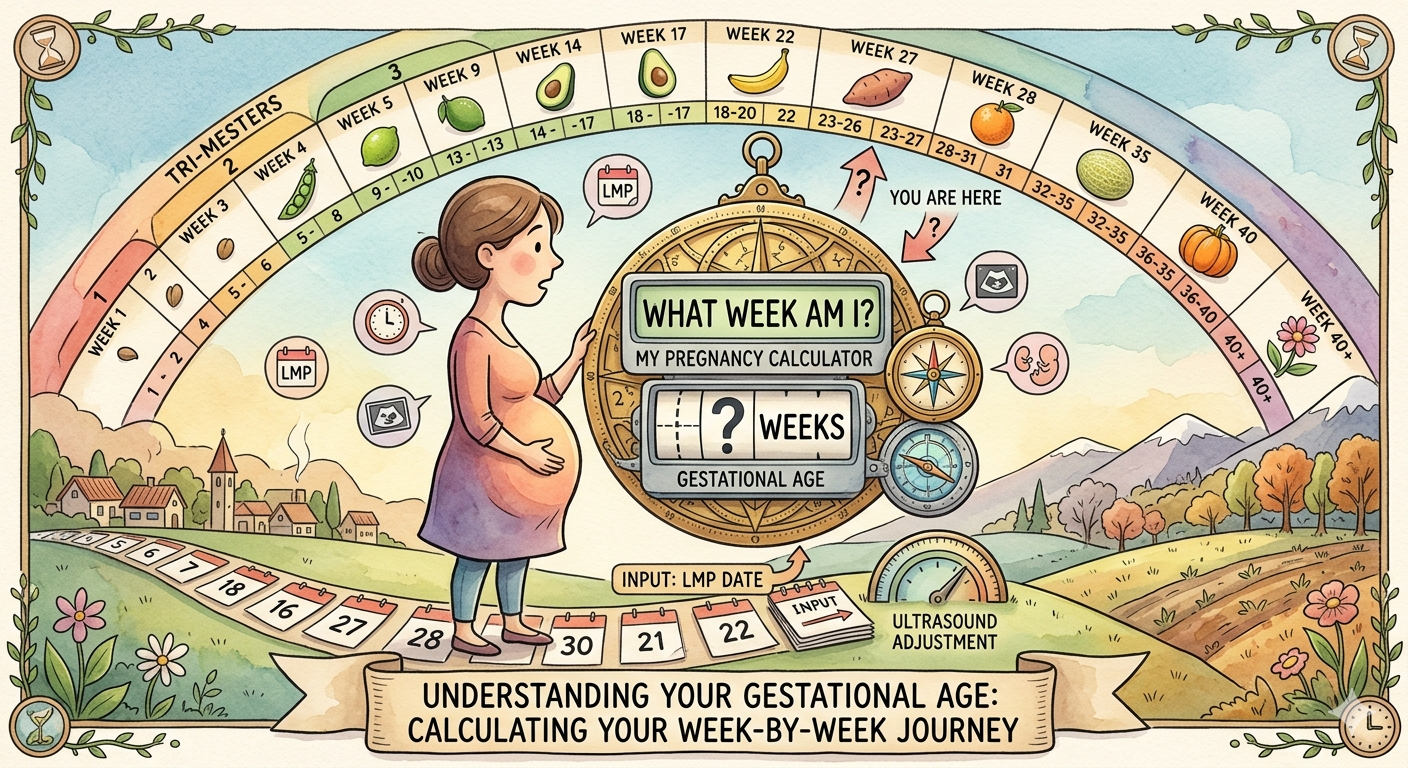
How to Calculate What Week You Are In Your Pregnancy
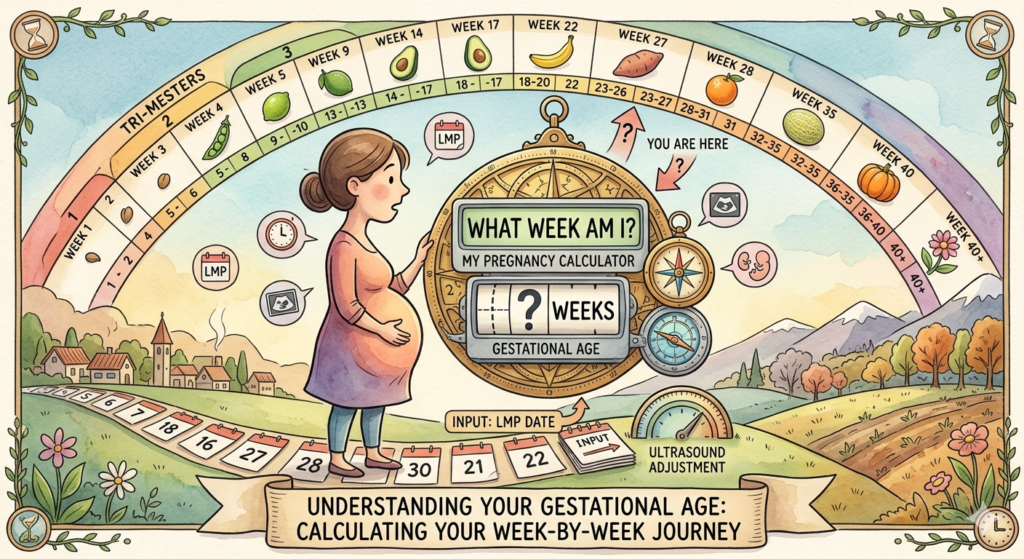
INTRO
What week am I in my pregnancy? One of the first questions every newly pregnant woman asks — right after the initial shock and joy of a positive test — is what week am I in my pregnancy? It sounds like it should be a simple question. But pregnancy dating is actually one of the most commonly misunderstood aspects of early pregnancy and it confuses a lot of women when they first encounter it. If you feel like your doctor is counting your pregnancy weeks differently from what you expected you are not imagining it. In this article we are going to explain exactly how pregnancy weeks are calculated, why the method used by doctors may feel counterintuitive, how to find out what week you are in right now, and what is happening with your baby during each major phase of those 40 weeks.
How Are Pregnancy Weeks Calculated?
Pregnancy is calculated in weeks — 40 weeks in total — measured from a specific starting point. Understanding which starting point is used explains why the math can initially feel confusing.
Most people assume pregnancy is counted from the moment of conception — the day the sperm fertilized the egg. But that is not how doctors count it.
Pregnancy weeks are counted from the first day of your last menstrual period (LMP) — not from conception. This means that on the day you actually conceive you are already considered approximately 2 weeks pregnant in medical terms.
The reason for this is practical — most women know when their last period started even if they do not know exactly when they ovulated or conceived. The LMP date is a consistent, recordable reference point that allows for standardized pregnancy dating.
Use our Free Due Date Calculator to find out what week you are in right now — simply enter the first day of your last period and your due date and current pregnancy week are calculated instantly.
The Simple Formula for Calculating Your Pregnancy Week
Here is the straightforward calculation you can do yourself.
Step 1: Find the first day of your last menstrual period. This is your starting point — day 1 of week 1.
Step 2: Count the number of days from that date to today.
Step 3: Divide that number by 7 to convert days into weeks.
Step 4: The result is your current gestational age in weeks.
For example: if your last period started 56 days ago you are 56 divided by 7 equals 8 weeks pregnant.
Most women find it easiest to skip the mental arithmetic entirely and use our Free Due Date Calculator — enter your LMP date and it calculates your current week, your due date, and your trimester instantly.
Gestational Age vs Fetal Age — What Is the Difference?
This is where many women get confused — and understandably so.
Gestational Age
Gestational age is the standard medical measure of how far along a pregnancy is. It counts from the first day of your last menstrual period and is the number your doctor uses when they say you are 8 weeks pregnant or 20 weeks pregnant.
Gestational age includes the approximately 2 weeks before conception when your body was preparing to ovulate but the pregnancy had not yet begun. This is why a 40-week pregnancy only involves approximately 38 weeks of actual fetal development.
Fetal Age
Fetal age — sometimes called embryonic age or conception age — counts from the actual moment of fertilization. It is always approximately 2 weeks less than gestational age.
When your doctor says you are 8 weeks pregnant (gestational age) the embryo has been developing for approximately 6 weeks (fetal age). When you are 20 weeks pregnant the baby has been developing for approximately 18 weeks.
For practical purposes gestational age is the number that matters in pregnancy — it is what your doctor uses, what pregnancy apps use, and what your due date is calculated from. Fetal age is rarely used in clinical practice.
What If I Do Not Know My Last Period Date?
Not every woman remembers the exact start date of her last period — particularly if her cycles are irregular or she was not tracking. If you do not know your LMP date there are other ways to estimate your gestational age.
Conception Date Method
If you know approximately when you conceived — for example if you were tracking ovulation with OPK tests and know your LMP date — you can add 14 days to your conception date to get the equivalent LMP date and use that for your calculation.
Our Free Due Date Calculator has a conception date option built in — select the conception date tab and enter the date you believe you conceived and your due date is calculated automatically.
Ultrasound Dating
A first trimester ultrasound — ideally performed between 8 and 14 weeks of pregnancy — is the most accurate method for dating a pregnancy when the LMP date is unknown or uncertain. The sonographer measures the crown-rump length (CRL) of the embryo or fetus — a measurement that is highly predictable in the first trimester and can date the pregnancy to within 3 to 5 days.
According to the American College of Obstetricians and Gynecologists, ultrasound dating in the first trimester is more accurate than LMP dating and should be used to establish or confirm gestational age when there is a discrepancy of more than 5 to 7 days between the LMP-based estimate and the ultrasound measurement.
Irregular Cycle Adjustment
If your cycles are significantly longer or shorter than 28 days your LMP-based due date may be off by the same number of days as your cycle deviates from 28. For example if your cycle is consistently 35 days you likely ovulate around day 21 rather than day 14 — making you approximately 7 days less pregnant than the standard LMP calculation suggests.
Our Free Due Date Calculator accounts for cycle length — enter your actual average cycle length and it adjusts your due date calculation accordingly.
The Three Trimesters — What Week Does Each Begin?
Pregnancy is divided into three trimesters — a framework that helps organize prenatal care, developmental milestones, and the physical experience of pregnancy.
First Trimester — Weeks 1 to 12
The first trimester runs from week 1 through the end of week 12. This is the period of most rapid early development — by the end of the first trimester all of the baby’s major organs have formed, the heart is beating, and the embryo has become a fetus with recognizably human features.
The first trimester is also when the risk of miscarriage is highest — approximately 80% of all miscarriages occur in the first trimester. This is why many couples choose to wait until the end of the first trimester before sharing their pregnancy news more widely.
First trimester symptoms typically include nausea, fatigue, breast tenderness, frequent urination, and food aversions — all driven by rapidly rising hCG and progesterone levels.
Second Trimester — Weeks 13 to 27
The second trimester is often called the honeymoon trimester — for many women the nausea and extreme fatigue of the first trimester ease significantly as hCG levels plateau and the body adjusts to the hormonal environment of pregnancy.
The baby grows rapidly during the second trimester — from approximately 3 inches at 13 weeks to around 14 inches by 27 weeks. The baby begins moving — a milestone called quickening — typically felt for the first time between weeks 16 and 22. The anatomy scan ultrasound is performed around 18 to 20 weeks and reveals the baby’s sex if desired.
Third Trimester — Weeks 28 to 40
The third trimester is the final stretch — the period of the most significant fetal weight gain as the baby grows from approximately 2.5 pounds at 28 weeks to a full-term weight of typically 6 to 9 pounds at 40 weeks.
Third trimester symptoms include back pain, difficulty sleeping, frequent urination returning as the baby’s head descends into the pelvis, Braxton Hicks contractions, and increasing pelvic pressure. Prenatal appointments become more frequent — every 2 weeks from 28 to 36 weeks and weekly from 36 weeks until delivery.
Pregnancy Weeks to Months Conversion Chart
Doctors track pregnancy in weeks, but everyone else tends to ask “how many months along are you?” — and the conversion isn’t as clean as dividing by four, since a calendar month averages closer to 4.3 weeks. Here’s a commonly used approximate guide:
| Month | Weeks |
|---|---|
| Month 1 | Weeks 1–4 |
| Month 2 | Weeks 5–8 |
| Month 3 | Weeks 9–13 |
| Month 4 | Weeks 14–17 |
| Month 5 | Weeks 18–22 |
| Month 6 | Weeks 23–27 |
| Month 7 | Weeks 28–31 |
| Month 8 | Weeks 32–35 |
| Month 9 | Weeks 36–40 |
This is why a “9-month” pregnancy is actually 40 weeks rather than a clean 36 (9 × 4) — the extra weeks come from months averaging more than exactly 4 weeks each. Treat this chart as a helpful approximation for conversation, not a precise medical measurement — your doctor will always reference your exact week, not a month number.
Week by Week Pregnancy Milestones
Here is a concise overview of key developmental milestones at each stage of pregnancy.
Weeks 1 to 4
Weeks 1 and 2 are the pre-conception phase — ovulation and fertilization occur at the end of week 2. Implantation occurs in week 3 and hCG production begins. By week 4 the embryo is approximately the size of a poppy seed and the placenta and amniotic sac are beginning to form. A pregnancy test becomes reliably positive.
Weeks 5 to 8
The embryo develops rapidly. The heart begins beating at approximately 6 weeks — typically visible on transvaginal ultrasound. By week 8 the embryo is approximately the size of a raspberry and all major organ systems — including the brain, heart, lungs, kidneys, and digestive tract — are forming. Pregnancy symptoms are typically at their most intense during this phase.
Curious what symptoms to expect during this intense early phase? See our full guide to early pregnancy symptoms.
Weeks 9 to 12
The embryo is now officially a fetus. Facial features become more defined, fingers and toes are fully formed, and the fetus begins making small movements — though too small to feel yet. The nuchal translucency scan and first trimester blood screening are typically offered around weeks 11 to 13.
Weeks 13 to 16
The second trimester begins. The risk of miscarriage drops significantly. The placenta is fully formed and takes over hormone production from the corpus luteum. The fetus grows rapidly and begins swallowing amniotic fluid. Many women begin to show a visible baby bump during this phase.
Weeks 17 to 20
The anatomy scan ultrasound at 18 to 20 weeks checks the baby’s anatomy in detail and can reveal the sex. Many women feel the first baby movements — a fluttering sensation called quickening — during this phase.
Weeks 21 to 27
The baby becomes increasingly active and movements become more pronounced and regular. The baby can hear sounds from the outside world. By week 24 the baby reaches the threshold of viability — the point at which survival outside the womb becomes possible with medical support.
Weeks 28 to 32
The third trimester begins. The baby gains weight rapidly — approximately half a pound per week. The brain develops significantly during this phase. Prenatal appointments now include monitoring for gestational diabetes and preeclampsia.
Weeks 33 to 36
The baby’s lungs mature in preparation for breathing outside the womb. The baby typically moves into a head-down position in preparation for birth. Many women experience increased pelvic pressure and Braxton Hicks contractions during this phase.
Weeks 37 to 40
The baby is considered full term from 37 weeks. Final weight gain occurs and the baby’s immune system continues to develop. Labor may begin at any point from 37 weeks onward. Most pregnancies deliver between weeks 38 and 41.
How Accurate Is the 40-Week Calculation?
The 40-week pregnancy duration is an average — not an exact guarantee. In reality only about 4% to 5% of babies are born on their exact due date. Most full-term babies arrive between 38 and 42 weeks of gestation.
Factors that influence when labor begins include the baby’s individual development timeline, maternal factors like whether this is a first or subsequent pregnancy (first-time mothers tend to go slightly past their due date more often), and the accuracy of the due date calculation itself.
A due date is best understood as the midpoint of a 5-week window — from 38 to 42 weeks — during which most births occur rather than a precise predicted delivery date.
For a deeper look at what’s happening hormonally in these early weeks, see our guide to hCG levels in early pregnancy.
Frequently Asked Questions
Am I 4 weeks pregnant from my last period or from conception?
From your last period. When doctors say you are 4 weeks pregnant they are counting from the first day of your last menstrual period. You would have conceived approximately 2 weeks ago. This is why at 4 weeks pregnant the embryo is actually only about 2 weeks old in terms of development.
Why does my pregnancy app say a different week than my doctor?
This is usually caused by a difference in the date entered as your LMP or a difference in how cycle length adjustments are applied. Confirm with your doctor which LMP date they are using as your reference point and enter the same date into our Free Due Date Calculator for a consistent result.
Can my due date change after an ultrasound?
Yes — particularly in the first trimester. If the ultrasound measurement of the embryo or fetus suggests a different gestational age than the LMP calculation your doctor may adjust your due date to reflect the ultrasound finding. This is most commonly done when there is a discrepancy of 5 to 7 days or more between the two estimates.
What week is considered full term?
A pregnancy is considered full term from 39 weeks and 0 days to 40 weeks and 6 days. Early term is 37 to 38 weeks and 6 days. Late term is 41 weeks to 41 weeks and 6 days. Post term is 42 weeks and beyond.
Is 12 weeks the same as 3 months pregnant?
Approximately — but pregnancy months and calendar months do not align perfectly. Because pregnancy is counted in weeks a pregnancy month is not exactly the same as a calendar month. At 12 weeks you are at the end of your third month of pregnancy in general terms but the first trimester officially ends at the end of week 12 regardless of how many calendar months have passed.
What happens if my period dates are wrong?
If your LMP date is wrong — because you do not remember exactly when your period started or because your cycle was irregular — your calculated due date will also be off. This is why first trimester ultrasound dating is so valuable — it provides an objective measurement of the embryo’s size that does not depend on the accuracy of your LMP date.
The Bottom Line
Calculating what week you are in your pregnancy is straightforward once you understand that pregnancy weeks are counted from the first day of your last menstrual period — not from conception. This means you are already considered 2 weeks pregnant on the day you conceive and your 40-week pregnancy includes approximately 38 weeks of actual fetal development.
The fastest and most accurate way to find out what week you are in right now is to use our Free Due Date Calculator. Enter the first day of your last period and your current pregnancy week, trimester, and estimated due date are calculated instantly — along with key milestones like the end of your first trimester and your anatomy scan window.
If you are not yet pregnant and are still working on timing conception accurately use our Free Ovulation Calculator to find your fertile window and our Free Period Tracker to log your cycles so your LMP date is always accurate and recorded when you need it.
Medical Disclaimer: This article is for educational purposes only and does not constitute medical advice, diagnosis, or treatment. Pregnancy dating should always be confirmed by your doctor or midwife using clinical assessment and ultrasound where appropriate. Read our full Medical Disclaimer.




One Comment