
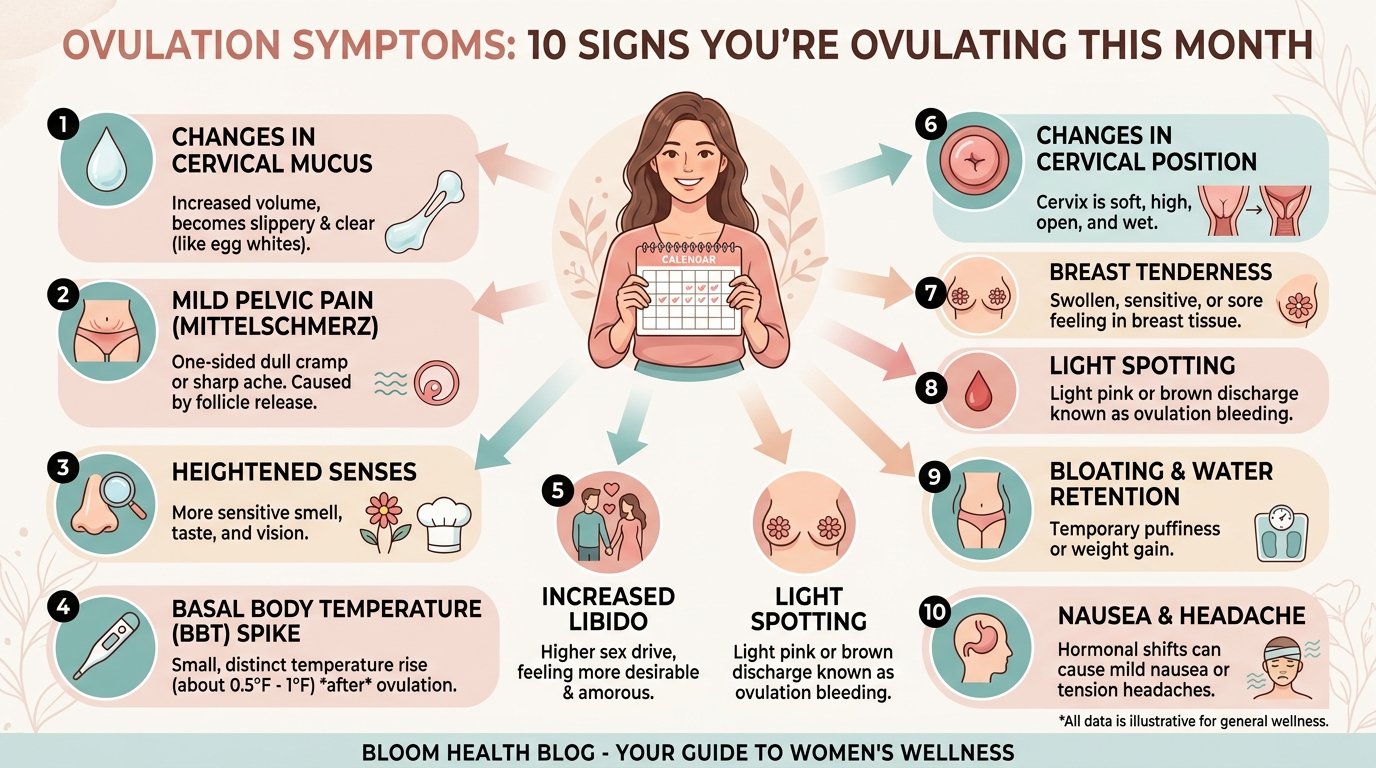
Ovulation Symptoms: 10 Signs You’re Ovulating This Month
If you’re trying to conceive — or simply want to understand your cycle better — knowing your ovulation symptoms is one of the most useful things you can do. Ovulation is the moment your ovary releases a mature egg, and your body gives you a surprising number of physical and hormonal signals when it happens. The problem is that most women were never taught what to look for.
This guide covers every major sign of ovulation, backed by research, so you can stop guessing and start tracking with confidence.
What Is Ovulation and Why Does It Matter?
Ovulation is the release of a mature egg (oocyte) from one of your ovaries, typically occurring once per menstrual cycle. After release, the egg survives for just 12 to 24 hours — making the window for fertilization extremely short. Sperm, however, can survive in the fallopian tubes for up to five days, which means your fertile window actually spans about six days: the five days before ovulation and ovulation day itself.
Understanding this timing is critical whether you’re trying to get pregnant or simply tracking your reproductive health. According to the American College of Obstetricians and Gynecologists (ACOG), ovulation typically occurs around day 14 of a 28-day cycle — but this varies significantly depending on your personal cycle length. Women with longer or shorter cycles ovulate earlier or later than day 14.
Use our free Ovulation Calculator to estimate your exact ovulation date based on your cycle length and last period.
10 Ovulation Symptoms to Watch For
1. Changes in Cervical Mucus — The Most Reliable Sign
The single most reliable physical indicator of approaching ovulation is a change in your cervical mucus. Throughout your cycle, vaginal discharge changes in texture, color, and volume in response to shifting hormone levels — specifically rising estrogen in the days before ovulation.
Here is what to expect across your cycle:
- After your period: Dry or very minimal discharge
- Several days before ovulation: Discharge becomes white or creamy, similar to lotion
- Approaching ovulation: Discharge becomes clear, slippery, and stretchy — closely resembling raw egg whites
- After ovulation: Discharge returns to thicker, cloudy, or dry
The egg white cervical mucus (EWCM) stage is your peak fertility signal. Research published in the journal Human Reproduction found that the presence of egg white mucus is strongly associated with higher pregnancy rates in the cycles it occurs. When you see this type of discharge, you are at or very close to your most fertile point.
How to check: Wash your hands, then insert a clean finger into your vagina or examine what appears on toilet paper after wiping. Look for the stretchy quality — fertile mucus should stretch between your fingers without breaking.
2. Mittelschmerz — Ovulation Pain
About one in five women experience a distinct one-sided pelvic pain at the time of ovulation, known medically as mittelschmerz — a German word meaning “middle pain.” This pain occurs on whichever side the follicle ruptures, and it can feel like:
- A dull ache or cramp on one side of the lower abdomen
- A sharp, brief twinge
- A sensation that lasts anywhere from a few minutes to a couple of hours
- Occasionally, pain that persists for 24–48 hours
Mittelschmerz is caused by the follicle swelling and then releasing fluid or a small amount of blood when it ruptures. The surrounding tissue is briefly irritated. While uncomfortable, it is entirely harmless and actually a very useful fertility signal — it tells you precisely which side you are ovulating from that cycle.
Learn more about this phenomenon in our detailed guide to ovulation pain and mittelschmerz.
3. A Surge in Libido
Many women report a noticeable increase in sexual desire in the days leading up to ovulation. This is not coincidental — it is your body’s biological mechanism to encourage reproduction at the optimal time.
The surge is driven by rising estrogen levels in the follicular phase, followed by the LH (luteinizing hormone) surge that triggers ovulation. Research published in Hormones and Behavior confirmed that women’s sexual interest peaks significantly in the days around ovulation, independent of relationship status or partner behavior.
For women tracking fertility, this natural increase in desire can serve as an additional signal that your fertile window is open — particularly when combined with other symptoms.
4. The LH Surge — Detectable with OPK Tests
The most scientifically direct way to confirm approaching ovulation is to detect the luteinizing hormone (LH) surge using an ovulation predictor kit (OPK). LH is released by the pituitary gland approximately 24 to 36 hours before ovulation. Home OPK test strips detect when urinary LH levels spike above a threshold, giving you advance warning that ovulation is imminent.
Key points about OPK testing:
- Test daily starting a few days before your expected ovulation date
- Test at the same time each day — afternoon (between 12pm and 8pm) is generally recommended, as the LH surge often begins in the morning but takes hours to appear in urine
- A positive OPK (test line as dark as or darker than control line) indicates ovulation will likely occur within 12–36 hours
- Women with PCOS may have persistently elevated LH and get false-positive results — consult your doctor if this is a concern
Our Pregnancy Test Calculator can help you determine the best time to test after your OPK turns positive.
5. Breast Tenderness or Sensitivity
Breast tenderness is commonly associated with PMS, but many women also experience it around ovulation. The cause is slightly different at each stage: around ovulation, the estrogen surge and the subsequent rise in progesterone after ovulation can both cause breast tissue sensitivity.
Ovulation-related breast tenderness typically feels like mild sensitivity or heaviness, usually appearing right at or just after ovulation (not before, as with typical PMS symptoms). If you track when your breast tenderness starts each cycle, you may notice a pattern that correlates with your ovulation timing.
6. Light Spotting or Cervical Bleeding
A small percentage of women notice very light spotting — sometimes pink or brown in color — around the time of ovulation. This is called ovulation spotting and is thought to be caused by the brief drop in estrogen just before the LH surge, which can cause a small amount of uterine lining to shed temporarily.
Ovulation spotting is:
- Very light (typically just a few spots, not a flow)
- Pink or light brown in color
- Lasting no more than a day or two
- Occurring mid-cycle, well away from your period
If spotting occurs outside of mid-cycle, is heavy, or is accompanied by pain, consult your healthcare provider as it may indicate a different cause.
7. A Rise in Basal Body Temperature
Basal body temperature (BBT) is your body’s resting temperature, measured first thing in the morning before any activity. When you are in the follicular phase (before ovulation), your BBT stays relatively low. After ovulation, the corpus luteum produces progesterone, which raises your BBT by approximately 0.2°C to 0.5°C (0.4°F to 1°F) — and it stays elevated until your next period.
This temperature shift confirms that ovulation has already occurred. BBT tracking therefore tells you retrospectively when you ovulated, helping you learn your pattern over several cycles.
How to use BBT tracking effectively:
- Use a basal thermometer (reads to two decimal places) rather than a regular thermometer
- Take your temperature at the same time every morning before getting out of bed
- Chart your readings over several cycles to identify your personal temperature shift pattern
- Combine with cervical mucus tracking for the most complete picture
Read our complete guide to Basal Body Temperature Charting for step-by-step instructions, chart examples, and what your BBT patterns mean.
8. Heightened Senses — Smell, Taste, and Vision
Several studies have found that women’s sensory acuity — particularly the sense of smell — temporarily sharpens around ovulation. A study published in Chemical Senses found that women could detect the subtle musky scent of androstenone more acutely around ovulation than at other cycle phases. Similar research has noted improved color perception and taste sensitivity.
These changes are subtle and not universally noticed, but women who track their cycles closely sometimes report being more sensitive to smells, more easily distracted by scents they find attractive, or simply more visually alert in the days around ovulation.
9. Cervical Position Changes
For women who choose to check internally, the cervix itself provides reliable ovulation clues. This is a practice used in the Fertility Awareness Method (FAM) and requires a learning curve, but once familiar, it is a useful confirmation tool.
Here is how the cervix changes across the cycle:
| Phase | Position | Texture | Opening |
|---|---|---|---|
| After period / early follicular | Low | Firm (like tip of nose) | Closed |
| Approaching ovulation | High | Soft (like lips) | Open |
| Post-ovulation / luteal | Low again | Firm again | Closed |
The acronym SHOW is often used to remember peak fertility signs: Soft, High, Open, Wet.
10. Bloating and Water Retention
Mild abdominal bloating around mid-cycle is a common but often overlooked ovulation symptom. The hormonal surge — particularly rising estrogen and LH — can cause your body to temporarily retain water, leading to a bloated feeling. Some women also notice their rings or shoes feel slightly tighter during this time.
Unlike the bloating of PMS (which tends to be more pronounced and accompanied by other symptoms), ovulation bloating is usually mild, brief, and unaccompanied by digestive upset.
Signs That Ovulation Is Over
Once ovulation has occurred, your body enters the luteal phase — the second half of your cycle. The signs that ovulation is over include:
- Cervical mucus returns to thick, cloudy, or dry
- BBT rises and stays elevated
- Ovulation pain (if you experienced it) subsides completely
- Cervix moves back down and firms up
- Energy levels may start to decrease gradually
The luteal phase typically lasts 12 to 16 days. If fertilization does not occur, your period will arrive at the end of this phase. If you are trying to conceive, the luteal phase is when implantation may occur — typically between 6 and 12 days after ovulation.
Use our Implantation Calculator to estimate your personal implantation window and the earliest date a pregnancy test might turn positive.
How Many Days Do Ovulation Symptoms Last?
Most physical ovulation symptoms are brief. Here is a general timeline:
- Egg white cervical mucus: 1–5 days, peaking on the day of ovulation
- LH surge: approximately 24–48 hours
- Mittelschmerz: minutes to 48 hours
- Increased libido: 3–5 days around ovulation
- Spotting: 1–2 days maximum
- BBT shift: lasts throughout the luteal phase (12–16 days)
If you experience symptoms lasting significantly longer than these timeframes, or if symptoms are unusually severe, speak with your healthcare provider.
Ovulation Symptoms vs. Pregnancy Symptoms
One of the most commonly asked questions is whether ovulation symptoms feel different from early pregnancy symptoms. The answer is: some overlap significantly, which is why the two-week wait is so confusing.
| Symptom | Ovulation | Early Pregnancy |
|---|---|---|
| Breast tenderness | Possible | Common |
| Bloating | Yes | Yes |
| Spotting | Light, mid-cycle | Possible (implantation bleeding) |
| Cramping | Typically one-sided | Mild, central |
| Increased discharge | Yes (EWCM) | Yes (white/milky) |
| Fatigue | Possible | Very common |
| Nausea | Rare | Very common |
The key distinguishing factor is timing. Ovulation symptoms occur at mid-cycle. Early pregnancy symptoms typically do not begin until after implantation — which is at the earliest 6 days after ovulation, and more commonly 8 to 10 days after. If you are experiencing symptoms in the days immediately after your expected ovulation date, they are more likely ovulation-related or luteal phase effects of progesterone than pregnancy symptoms.
What If You Have No Ovulation Symptoms?
It is entirely possible to ovulate without noticing any physical symptoms at all. Many women with perfectly regular cycles and healthy fertility feel nothing during ovulation. The absence of symptoms does not mean you are not ovulating.
Conversely, having strong ovulation symptoms does not guarantee fertility. The only way to confirm that ovulation is producing a mature, viable egg is through monitoring under medical supervision (blood tests for progesterone, ultrasound follicle tracking).
If you are concerned that you may not be ovulating — particularly if your periods are irregular, very light, very heavy, or absent — speak with your OB-GYN or a reproductive endocrinologist. Signs that ovulation may not be occurring regularly include:
- Cycles shorter than 21 days or longer than 35 days
- Very irregular cycle lengths that vary by more than 7–9 days
- Absent periods (amenorrhea)
- You have been trying to conceive for 12 months (or 6 months if you are 35 or older) without success
How to Track Ovulation Accurately
The most reliable approach to ovulation tracking combines multiple methods rather than relying on just one:
1. Use our free tools
Start with the Ovulation Calculator to get a baseline estimate of your fertile window based on your cycle length. Pair this with the Period Tracker to spot patterns across multiple cycles.
2. Track cervical mucus daily
Record what you observe each day — dry, sticky, creamy, or egg white. This is free, requires no equipment, and is one of the most research-supported methods.
3. Use OPK test strips
Start testing 3–4 days before your estimated ovulation date. Many women use inexpensive strip tests rather than expensive digital monitors — both are equally effective at detecting the LH surge.
4. Chart your BBT
Invest in a basal thermometer (typically $10–$20) and chart your temperature daily. After 2–3 cycles of charting, you will clearly see your personal temperature shift pattern.
5. Consider a fertility awareness app
Apps that allow you to input multiple data points — mucus, temperature, OPK results, and cycle dates together — give you a more complete picture than apps that rely on cycle length predictions alone.
Frequently Asked Questions
How do I know if I’m ovulating?
The most reliable combination of signs is egg white cervical mucus, a positive OPK test, and a subsequent rise in basal body temperature. Any one of these alone is helpful, but together they give you a high degree of confidence.
Can I feel myself ovulate?
Some women feel a distinct twinge or cramp (mittelschmerz) at the moment of ovulation, but most do not. The absence of feeling does not mean ovulation did not occur.
Is it normal to have ovulation symptoms every month?
Yes, if your cycles are regular. The type and intensity of symptoms may vary slightly from cycle to cycle, which is also normal.
Do ovulation symptoms change with age?
Yes, they can. As you approach perimenopause, cycles may become more irregular and ovulation may become less predictable. Some women find that symptoms become more pronounced; others notice them less.
Can you have ovulation symptoms but not ovulate?
Yes, in some cases — particularly in women with PCOS who may experience an LH surge without actually releasing an egg (called a luteinized unruptured follicle, or LUF syndrome). If you are concerned, a blood progesterone test 7 days after suspected ovulation can confirm whether ovulation occurred.
What does ovulation discharge look like?
At peak fertility, ovulation discharge is clear, slippery, and stretchy — similar to raw egg white. This is your most fertile mucus and signals that ovulation is imminent or occurring.
Related Tools and Resources on FeminaTrack
- 🥚 Ovulation Calculator — Find your fertile window instantly
- 🌙 Period Tracker — Predict your next 6 periods
- 🌱 Implantation Calculator — Estimate when implantation may occur
- 🧪 Pregnancy Test Calculator — Find the best day to test
- 📊 Fertility Score Quiz — Get your personalised fertility wellness score
References and Further Reading
- Stanford JB, White GL, Hatasaka H. “Timing intercourse to achieve pregnancy: current evidence.” Obstet Gynecol. 2002;100(6):1333-1341. PubMed
- Bigelow JL, Dunson DB, Stanford JB, et al. “Mucus observations in the fertile window: a better predictor of conception than timing of intercourse.” Human Reproduction. 2004;19(4):889-892. Oxford Academic
- Gangestad SW, Thornhill R. “Human oestrus.” Proc Biol Sci. 2008;275(1638):991-1000. NCBI
- American College of Obstetricians and Gynecologists. “Fertility Awareness-Based Methods of Family Planning.” ACOG Practice Bulletin No. 206. Obstetrics & Gynecology. 2019. ACOG.org
- Mayo Clinic. “Ovulation signs: When is conception most likely?” MayoClinic.org
Last reviewed: October 2026 | Medically referenced against ACOG and peer-reviewed research | See our Medical Review Policy and Disclaimer