Cervical Mucus Stages: Complete Guide to Your 4 Fertile Phases & Best Days to Conceive
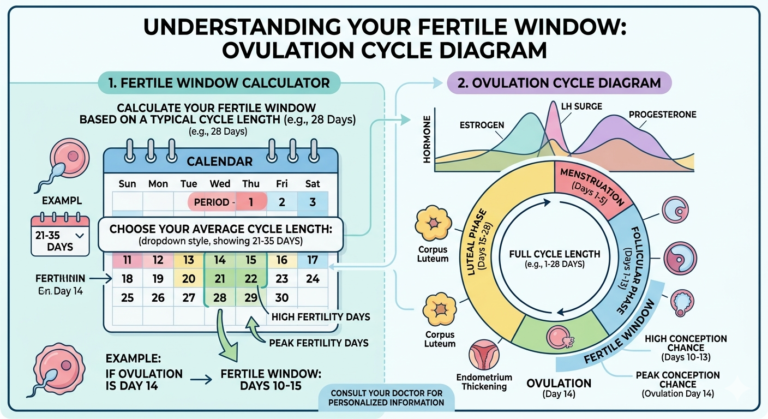
Cervical mucus stages is your body’s most honest, accurate fertility gauge — and yet it’s the most underused tool in trying to conceive. Unlike calendars or apps, which can only estimate your fertile window based on averages, cervical mucus changes are real-time biological signals telling you exactly when sperm can survive, swim, and meet an egg.
When tracked correctly, cervical mucus observation alone can identify your fertile window with 97% accuracy<sup>1</sup> — comparable to medical-grade fertility monitors. Combined with cycle dating and basal body temperature tracking, it gives you near-perfect certainty of your best days to try.
This comprehensive guide walks you through every detail: what cervical mucus actually is, the biological mechanism behind its changes, the 4 distinct stages with visual and tactile descriptions, how to track properly, common variations and irregularities, and exactly how to time intercourse for the highest chance of conception.
What Is Cervical Mucus & Why Does It Change?
Cervical mucus is a gel-like fluid produced by specialized glands in the cervix — the lower, narrow end of the uterus that connects to the vagina. Throughout your menstrual cycle, fluctuating levels of estrogen and progesterone dramatically alter the quantity, consistency, and chemical composition of this fluid<sup>2</sup>.
These changes are not random — they serve a precise biological purpose:
- After your period: Low estrogen = little to no mucus → natural barrier prevents infection and sperm entry
- As you approach ovulation: Rising estrogen signals the cervix to produce more mucus — thinning it, making it alkaline, and adding water and electrolytes to create a sperm-friendly environment
- At peak fertility: Mucus mirrors semen in pH and nutrient content — nourishes sperm, filters out abnormal cells, and guides them through the cervix into the uterus and fallopian tubes
- After ovulation: Progesterone surges — mucus thickens rapidly into a dense, impenetrable plug that blocks sperm entry and protects the potential implantation site<sup>3</sup>
Sperm survival directly reflects mucus quality:
- In hostile/dry mucus: Minutes to hours only
- In transitional mucus: 12–24 hours
- In peak-fertility mucus: Up to 5 days<sup>4</sup>
This is why understanding your cervical mucus stages is the single most powerful way to identify your true fertile window — and why apps alone often miss it. Combine what you see here with our Ovulation Calculator for double confirmation.
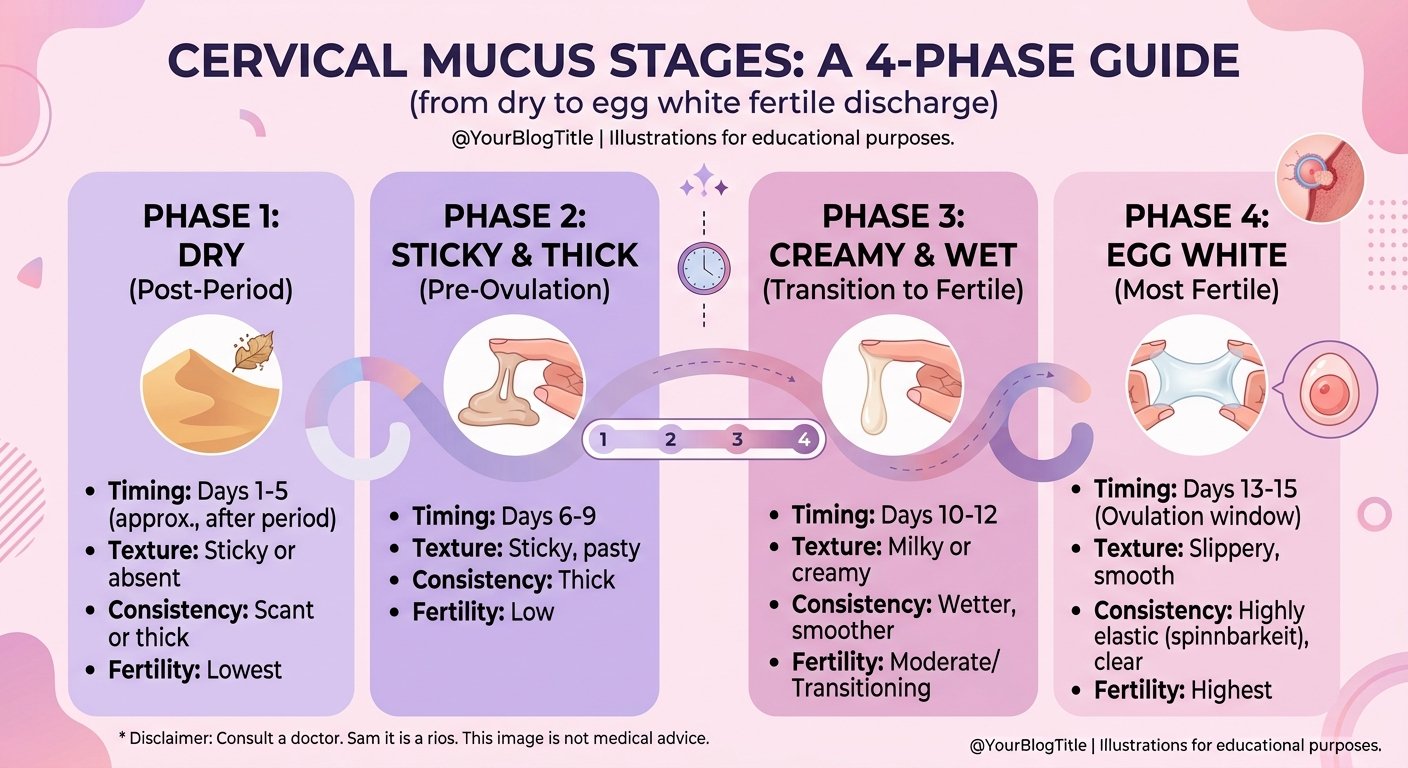
The 4 Cervical Mucus Stages — Detailed Breakdown
Every woman’s pattern is slightly different, but nearly everyone follows this recognizable progression. The shift from one stage to the next is gradual — you may see mixed patterns on transition days.
Stage 1 — Dry Days (Low Fertility)
Timing: Immediately following your period, typically Days 4–7 of a 28-day cycle
Duration: 2–5 days — shorter in shorter cycles, longer in longer cycles
Visual & Physical Signs:
- Little to no discharge visible on underwear or tissue
- Sensation of dryness at the vaginal opening
- No visible moisture or sheen
- Occasionally a tiny amount of thick white or pale yellow paste — this is residual, not fertile mucus
Biology:
- Estrogen levels are at their cycle baseline
- Cervical crypts remain closed and minimally active
- What little mucus exists is thick, acidic, and low in water content
- Sperm cannot penetrate or survive in this environment — typically dies within 1–2 hours<sup>5</sup>
What This Means:
- Conception risk is extremely low — less than 2% for most women
- Use this time to establish your baseline — notice what “dry” truly feels like
- Start checking daily from the first day you notice any moisture
- Do not assume you are infertile forever — dryness is temporary and will shift
⚠️ Important: In very short cycles (under 24 days), ovulation can occur before dryness even develops or immediately after your period ends. Always watch for the next stage to begin.
Stage 2 — Sticky / Tacky Mucus (Fertility Rising)
Timing: Usually Days 6–10, roughly 3–6 days before ovulation
Duration: 1–3 days — the shortest transitional phase for many
Visual & Physical Signs:
- Small amounts of thick, opaque discharge — white, cream, or pale yellow
- Texture like paste, glue, or dried lotion
- Forms small clumps or flakes on tissue
- Feels tacky, sticky, or slightly “gummy” at the opening
- When stretched between fingers, breaks immediately — less than ¼ inch stretch
- Dries quickly — crusty or flaky on underwear
Biology:
- Estrogen is rising but not yet at threshold levels
- Water content in mucus increases from ~2% to roughly 10–25%
- pH slowly becoming less acidic but still hostile
- Sperm survival improves to roughly 6–12 hours — still not optimal
- Cervix begins to soften and rise internally — you may not feel this, but it’s happening
What This Means:
- Your cycle is active and progressing toward ovulation
- Fertility is awakening — risk rises from near-zero to roughly 10% by the end of this stage
- Begin checking twice daily — morning and evening — because the shift to creamy can happen in just 24 hours
- You can conceive if ovulation happens early and sperm are already waiting — the “sperm reservoir” is beginning to form
- Consider starting every-other-day intercourse from this point onward if you want to be proactive
Stage 3 — Creamy / Lotiony Mucus (High Fertility Approaching)
Timing: Days 10–14, roughly 2–4 days before ovulation
Duration: 2–4 days — highly variable among women
Visual & Physical Signs:
- Increased quantity — noticeable moisture on tissue and underwear
- Color: opaque milky white, cream, or pale ivory — never fully clear
- Texture: smooth, creamy, consistent like hand lotion, full-fat milk, or yogurt
- No lumps, clumps, or stickiness — flows when tilted
- Stretches ¼–½ inch before breaking — thinner than egg white but more elastic than sticky
- Sensation: moist, wet, or lubricated — but not the distinct slipperiness of peak mucus
- Leaves a faint white or cream stain on underwear
Biology:
- Estrogen is now significantly elevated — roughly 3–5x baseline levels
- Water content rises to 50–70% — mucus becomes more liquid
- pH neutralizing — becoming hospitable to sperm
- Glycoprotein matrix loosens — creating channels for sperm to swim through
- Sperm survival extends to 2–3 days — a functional reservoir forms in the cervix<sup>6</sup>
- LH (luteinizing hormone) surge may begin toward the end of this stage
What This Means:
- You are entering your fertile window — conception risk is now 20–30% per cycle day
- Sperm deposited here will survive until ovulation — try every other day to cover this period
- This is the stage where most women “feel” their fertility change — trust the sensation
- Continue tracking — the transition to egg white is the critical signal
- Cross-reference with our Ovulation Calculator — your calculated fertile window should align with these physical signs
Stage 4 — Egg White Cervical Mucus / EWCM (Peak Fertility)
Timing: The final 1–2 days before ovulation + the day of ovulation itself
Duration: 1–3 days — very short — do not miss this window
Visual & Physical Signs:
- Abundant — significant quantity, often described as “gushing” or “flooding”
- Color: crystal clear, translucent, or slightly cloudy (like raw egg white)
- Texture: slippery, stretchy, elastic — identical to the white of a freshly cracked egg
- Stretch test: pulls 1–2+ inches between your fingers without breaking — thin, continuous, thread-like
- Sensation: intense lubrication — as if you’ve applied oil or lubricant — distinct slipperiness that remains even after wiping
- Shiny, reflective appearance on tissue
- No odor, no coloration beyond slight cloudiness
Biology:
- Estrogen peaks — highest level of your entire cycle
- Water content reaches 90–97% — mucus is almost entirely liquid<sup>7</sup>
- pH becomes alkaline — matching seminal fluid — protects sperm from vaginal acidity
- Glycoprotein strands align into parallel channels — sperm swim rapidly upward through these pathways
- Proteins and electrolytes nourish and energize sperm
- Sperm survival: 3–5 days — maximum longevity and motility
- This mucus actually selects healthy sperm — filtering out abnormally shaped or slow-moving cells
- Within hours of ovulation, estrogen drops and progesterone rises — this mucus vanishes rapidly, often within 12–24 hours<sup>8</sup>
What This Means:
- ⭐ THIS IS YOUR MOST FERTILE TIME — do not delay
- Conception probability per cycle day: 30–40% — the highest of any stage
- Intercourse on egg-white days gives the absolute best chance of pregnancy
- The first day you see EWCM is your signal to try — do not wait
- EWCM + positive OPK = confirmed ovulation within 12–36 hours
- Even if EWCM appears for only one day, that is sufficient — it only takes one encounter
- If you see EWCM but no ovulation occurs, it may mean a delayed or anovulatory cycle — track next cycle and consult your provider if this happens repeatedly
Visual Reference Table
Table
| Stage | Typical Timing | Color | Texture | Stretch | Sperm Survival | Conception Chance |
|---|---|---|---|---|---|---|
| Dry | Post-period | None | Absent | — | 1–2 hours | Very Low |
| Sticky | Days 6–10 | White/Yellow | Paste-like | <¼” | 6–12 hours | Low–Rising |
| Creamy | Days 10–14 | Milky White | Lotion-smooth | ¼–½” | 2–3 days | High |
| Egg White | 1–2 days pre-ovulation | Clear/Cloudy | Slippery, elastic | 1″+ | 3–5 days | ⭐ PEAK |
| Post-Peak | Post-ovulation | Thick/White | Drying up | Breaks instantly | Hours only | Low |
How to Track — Step-by-Step Protocol
Consistency and proper technique matter more than anything else. Follow this exact method for reliable results:
When & How to Check
- After every bathroom visit — before you wipe
- Observe what is already present on the tissue or at the opening
- Check internally only occasionally — external observation is sufficient for most
- Record: color, texture, quantity, stretch, and sensation immediately
- Note the sensation — dry, moist, wet, slippery — this is often the most reliable indicator
The Stretch Test
- Place a small amount between thumb and forefinger
- Slowly separate fingers
- Measure how far it stretches before breaking
- EWCM stretches without breaking — this is the definitive sign
What to Record
Create a simple daily log:
plaintext
Day 5: Dry — no moisture
Day 6: Dry — slight sticky residue
Day 7: Moist — white sticky paste, stretch <¼"
Day 8: Wetter — creamy lotion, stretch ¼"
Day 9: Very wet — clear stretchy, stretch 1"+ ← ACT NOW
Day 10: Drying — sticky again ← Ovulation likely passed
Triple Confirmation Method (Most Accurate)
For maximum certainty, combine three signals:
- Mucus observation — as detailed above
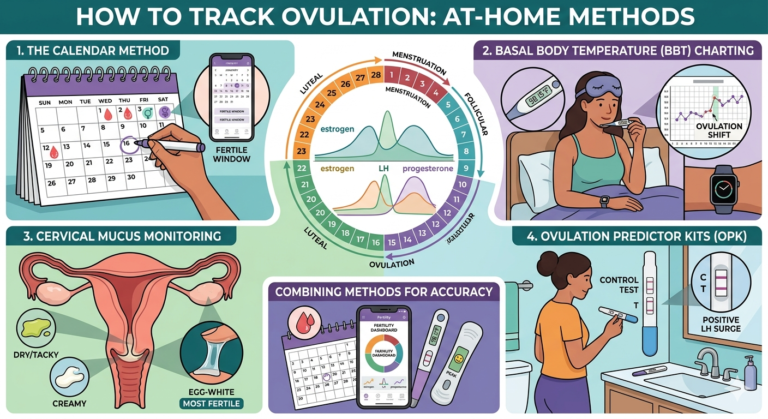
- Calendar calculation — our Ovulation Calculator estimates your window from period dates
- Basal Body Temperature (BBT) — temperature spike confirms ovulation after it happens
💡 Pro Tip: Mucus tells you before ovulation (when to try), temperature tells you after (when you’re done). Together they cover your cycle completely.
Common Variations & Irregularities
Short Luteal Phase
If your period arrives 7–10 days after EWCM ends, your luteal phase may be too short to sustain implantation. EWCM followed by period in under 12 days = consult your provider — this is treatable.
No EWCM Some Months
Stress, illness, travel, significant weight change, or hormonal fluctuations can suppress peak mucus. It does not mean you cannot conceive — but it does mean your window is harder to identify. Stay consistent — patterns vary cycle to cycle.
Mucus That Seems “Wrong”
- Yellow/green with odor: May indicate infection — see your provider
- Pink/brown streaks: Spotting — can happen mid-cycle with ovulation, or indicate hormonal imbalance
- Constant creamy without EWCM: May mean estrogen never peaks — track 2–3 cycles; consult if consistent
- Watery without stretch: Can be a variant of peak mucus — sperm survival is still good
Things That Alter Mucus Appearance
- Semen and lubricants — mask natural mucus; wait 12–24 hours to observe
- Vaginal products, douches, soaps — change pH and texture
- Hydration — drink plenty of water; dehydration thickens mucus
- Certain medications — antihistamines dry all body secretions, including cervical mucus<sup>9</sup>
Timing Intercourse — Exact Best Days
Table
| If You See… | Best Time to Try |
|---|---|
| Sticky mucus | Start every-other-day schedule — don’t wait |
| Creamy mucus | Try today and tomorrow — sperm survives 2–3 days here |
| First day of EWCM | Try immediately — do not wait |
| EWCM continues | Try every day or every other day while present |
| EWCM disappears / dries up | Ovulation has passed — stop trying for this cycle |
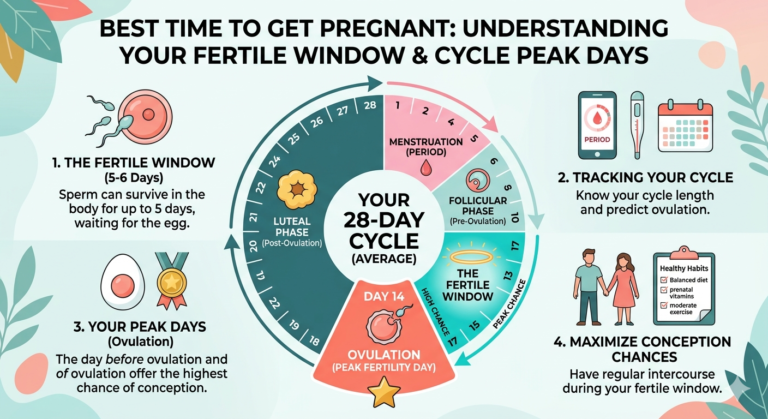
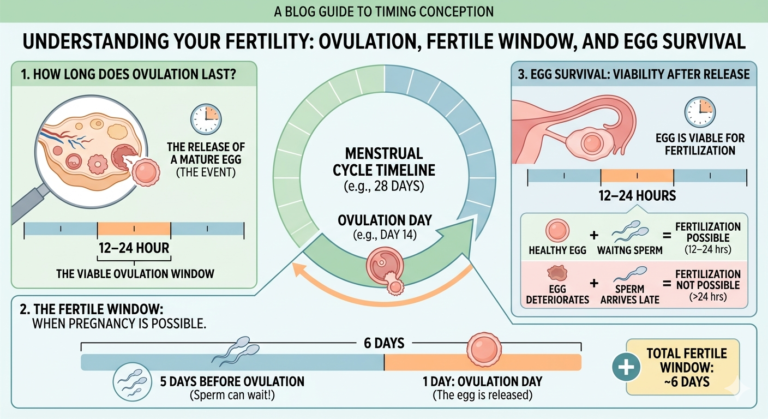
The Golden Rule: Sperm live longer than eggs. An egg survives only 12–24 hours after release. Sperm survive up to 5 days in EWCM. Therefore — the best strategy is sperm waiting for egg, not egg waiting for sperm<sup>10</sup>.
If you see EWCM:
- ✅ Try that same day — highest probability
- ✅ Continue while EWCM lasts
- ✅ Stop within 24 hours of mucus drying up — window has closed
Frequently Asked Questions
Can I get pregnant on dry days?
Extremely unlikely — less than 2% probability. Without fertile-type mucus, sperm cannot survive or travel effectively. However, in irregular or short cycles, ovulation can happen earlier than expected — always watch for moisture appearing.
Why do I have no egg white mucus?
Several possibilities: you’re checking too late (it can vanish within hours of ovulation), you’re dehydrated, estrogen levels are lower this cycle, or an anovulatory cycle occurred. If consistently absent across 3+ cycles, discuss with your OB-GYN — simple interventions can help.
Does EWCM always mean ovulation is coming?
Almost always — EWCM is an estrogen-driven event that precedes ovulation by roughly 24–48 hours. Rarely, EWCM can occur without subsequent ovulation. Confirm with BBT or OPK for certainty.
How long after EWCM does ovulation happen?
Typically 24–48 hours from the first appearance of EWCM. The last day of EWCM usually coincides with ovulation itself.
Can cervical mucus change after ovulation if pregnant?
Yes — if implantation occurs, rising estrogen and progesterone maintain increased discharge. It typically becomes thick, creamy, or milky white — but this is not a reliable pregnancy sign, as post-ovulation pre-period discharge looks identical.
Does cervical mucus method work for everyone?
It works for nearly everyone — but it takes 1–3 cycles to learn your unique pattern. Consistency is more important than perfection. Combine with our Ovulation Calculator for best results.
What if I see EWCM but my period still comes?
That means you identified your fertile window correctly — timing was not the issue. Conception is a biological probability game: even perfectly timed intercourse during peak fertility has only ~30% chance per cycle. Keep going — most couples under 35 conceive within 3–6 months of consistent tracking.
Can I use lubricants while TTC?
Most commercial lubricants harm sperm motility — including “natural” versions. If needed, use fertility-friendly lubricants or use your own cervical mucus as a guide — the presence of EWCM is nature’s confirmation that conditions are optimal.
Summary & Action Plan
Table
| Stage | What to Do |
|---|---|
| Dry | Begin daily checking — cycle is progressing |
| Sticky | Start every-other-day trying — don’t wait |
| Creamy | Continue — fertile window is open |
| Egg White | ⭐ TRY IMMEDIATELY — your highest chance |
| Drying up | Ovulation passed — test in 10–14 days |
Your FeminaTrack Tools to Use:
- 📅 Calculate your dates → Ovulation Calculator
- � Best test day → Pregnancy Test Calculator
- 📊 Implantation window → Implantation Calculator
- 📈 Track cycle history → Period Tracker
- 🧪 Confirm levels → hCG Levels Calculator
References
- American College of Obstetricians and Gynecologists — Fertility Awareness-Based Methods (2024)
- Mayo Clinic — Signs and Symptoms of Ovulation: Cervical Mucus Changes
- World Health Organization — Medical Eligibility Criteria for Fertility Awareness Methods
- American Society for Reproductive Medicine — Sperm Transport & Survival in the Female Reproductive Tract
- PubMed / NIH — Cervical Mucus Properties and Sperm Penetration Capacity
- NHS UK — Tracking Your Fertile Window: A Guide to Natural Family Planning
- Fertility and Sterility Journal — Water Content and Hydration Levels in Cervical Mucus Across the Menstrual Cycle
- European Journal of Obstetrics & Gynecology — Timing of Ovulation Relative to Peak Cervical Mucus
- Reproductive BioMedicine Online — Medications That Alter Cervical Mucus Consistency
- National Institute of Environmental Health Sciences — Optimal Intercourse Timing for Conception