
hCG Levels in Early Pregnancy: What Is Normal Week by Week?
If you have just gotten a positive pregnancy test and your doctor has ordered blood work, you have probably encountered the term hCG levels in early pregnancy — and possibly found yourself anxiously comparing your numbers to ranges you found online at 2am. You are not alone. hCG levels in early pregnancy are one of the most searched and most anxiety-inducing topics for newly pregnant women — and understandably so. They feel like a report card on how your pregnancy is doing. But here is the most important thing to understand before we dive into the numbers: hCG ranges in early pregnancy are extremely wide and individual variation is enormous. A single hCG number tells you very little. What matters much more is the trend — whether your levels are rising appropriately over time. In this article we are going to cover exactly what hCG is, what levels are considered normal week by week, what doubling time means, and what to do if your numbers feel concerning.
What Is hCG?
Human chorionic gonadotropin — hCG — is a hormone produced by the cells that will eventually form the placenta. It begins to be produced almost immediately after a fertilized egg implants in the uterine lining — typically 6 to 12 days after conception.
hCG serves several critical functions in early pregnancy. It signals the corpus luteum — the structure left in the ovary after ovulation — to keep producing progesterone, which is essential for maintaining the uterine lining and supporting the pregnancy. It also helps suppress the mother’s immune response to prevent the embryo from being rejected as foreign tissue. And it is the hormone that home pregnancy tests detect — its presence in urine above a certain threshold is what makes that second line appear.
hCG levels rise rapidly throughout the first trimester, typically peaking around weeks 8 to 10 before gradually declining to a plateau level that persists throughout the remainder of the pregnancy.
Use our Free hCG Calculator to check whether your hCG level falls within the normal range for your week of pregnancy — and to calculate your doubling time if you have two blood test results.
How Is hCG Measured?
hCG is measured in milli-international units per milliliter — written as mIU/mL. There are two main types of hCG tests.
Qualitative hCG Test
This is a simple yes or no test — it detects whether hCG is present above a certain threshold. Home pregnancy tests and basic urine tests at your doctor’s office are qualitative tests. They tell you whether you are pregnant but not how much hCG is in your system.
Quantitative hCG Test (Beta hCG)
This is a blood test that measures the exact amount of hCG in your bloodstream. It is called a beta hCG test or serum hCG test. When your doctor orders serial hCG tests — two or more blood draws taken 48 hours apart — they are looking at both the absolute level and the rate at which it is rising to assess how the pregnancy is developing.
According to the Cleveland Clinic, a quantitative hCG test is far more informative than a qualitative test for monitoring early pregnancy health because it allows your doctor to track the progression of hCG over time.
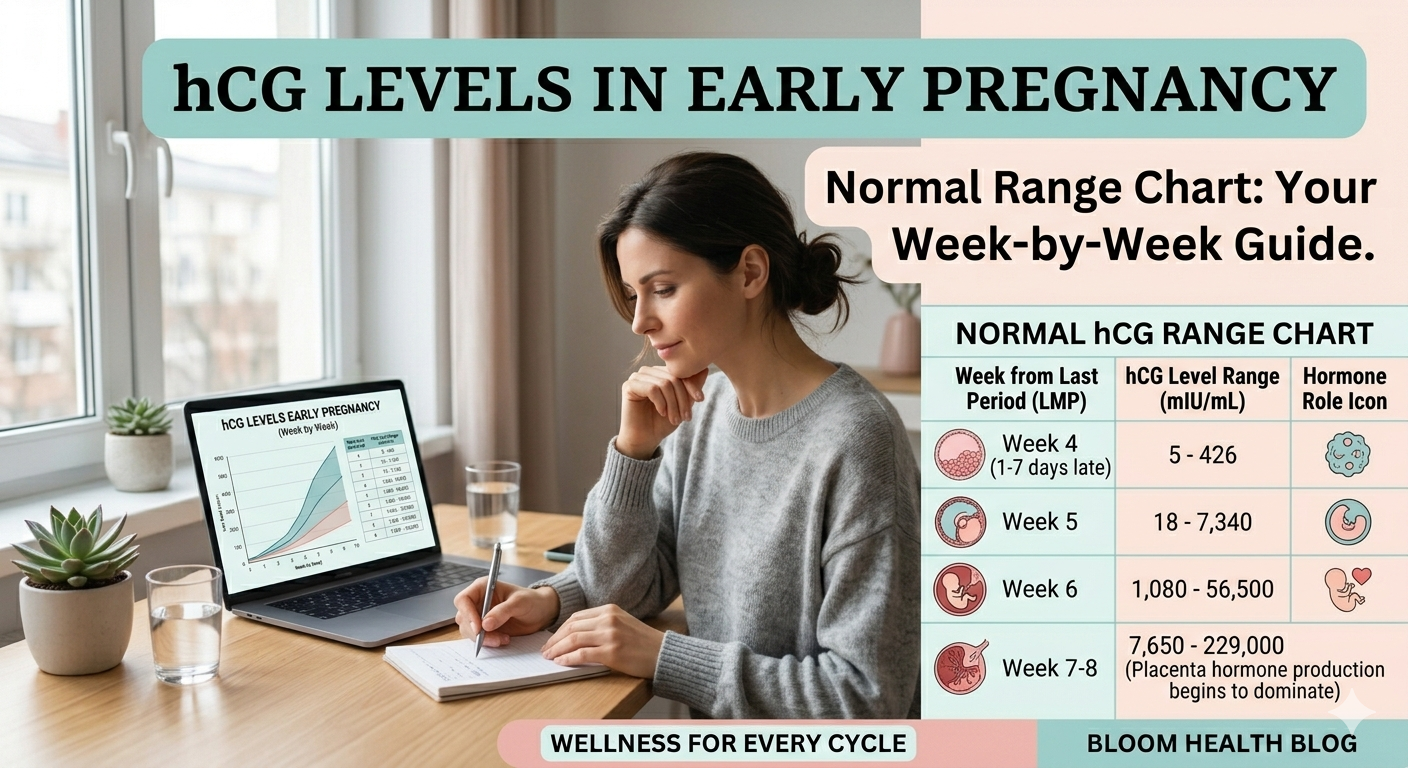
Normal hCG Levels by Week
The following ranges represent typical hCG levels measured from the first day of the last menstrual period (LMP) — the standard way pregnancy weeks are counted. Remember these are reference ranges compiled from population studies — individual variation within and even outside these ranges is common and does not automatically indicate a problem.
Use our Free hCG Calculator to instantly compare your specific level against these ranges for your week of pregnancy.
3 Weeks Pregnant (1 Week After Conception)
Normal range: 5 to 50 mIU/mL.
At this very early stage implantation is just occurring or has very recently occurred. hCG production is just beginning. Many home pregnancy tests may not yet be sensitive enough to detect these levels — though some early detection tests can.
4 Weeks Pregnant (2 Weeks After Conception)
Normal range: 5 to 426 mIU/mL.
This is around the time of a missed period for women with a 28-day cycle. The extremely wide range reflects how variable early hCG production is between women. A level of 10 mIU/mL and a level of 400 mIU/mL are both entirely normal at 4 weeks.
5 Weeks Pregnant
Normal range: 18 to 7,340 mIU/mL.
The range becomes even wider at 5 weeks as hCG levels begin rising more rapidly. This is why a single number at this stage is so difficult to interpret without context. What matters is whether the level is rising appropriately over 48-hour intervals.
6 Weeks Pregnant
Normal range: 1,080 to 56,500 mIU/mL.
By 6 weeks hCG levels are rising dramatically. A transvaginal ultrasound around this time may be able to detect a gestational sac and sometimes a fetal heartbeat — important milestones that provide reassurance alongside hCG levels.
7 to 8 Weeks Pregnant
Normal range: 7,650 to 288,000 mIU/mL.
This is typically the period of the most rapid hCG rise. Pregnancy nausea and other first trimester symptoms often peak around this time as hCG reaches its highest levels.
9 to 12 Weeks Pregnant
Normal range: 25,700 to 288,000 mIU/mL.
hCG levels begin to plateau and may start to decline slightly as the placenta matures and takes over progesterone production from the corpus luteum. This plateau is completely normal and does not indicate a problem. Many women notice their first trimester symptoms beginning to ease around this time as hCG levels stabilize.
13 to 16 Weeks Pregnant
Normal range: 13,300 to 254,000 mIU/mL.
The second trimester begins and hCG levels continue their gradual decline from the first trimester peak. Symptoms typically improve significantly during this phase for most women.
Second and Third Trimester
Normal range: 4,060 to 165,400 mIU/mL declining gradually throughout the remainder of pregnancy.
hCG levels in the second and third trimesters are much lower than in the first trimester and are not routinely monitored unless there is a specific clinical reason to do so.
hCG Levels in Twin or Multiple Pregnancy
If you’re carrying twins or another multiple pregnancy, your hCG levels will typically run higher than a singleton pregnancy at the same point in gestation — since more placental tissue is producing the hormone, more hCG generally gets produced. However, there isn’t a separate, medically validated “twin hCG chart” that can reliably confirm a multiple pregnancy on its own. The normal singleton ranges above are already so wide that a twin pregnancy’s higher-than-typical level can overlap significantly with what’s still considered a normal singleton range, and the reverse is also true.
The only reliable way to confirm a twin or multiple pregnancy is an ultrasound, typically performed around 6 to 9 weeks, once a gestational sac (or more than one) becomes visible. If your result from our Free hCG Calculator comes back above the typical range for your week, that alone doesn’t confirm twins — mention it to your doctor, who may recommend an earlier ultrasound to check.
What Is hCG Doubling Time and Why Does It Matter?
In a healthy early pregnancy hCG levels do not just rise — they rise at a predictable rate. This rate of increase is called the doubling time and it is one of the most important indicators of early pregnancy health.
In a healthy pregnancy hCG levels typically double every 48 to 72 hours up to approximately 6 weeks. After that the doubling time slows to approximately every 72 to 96 hours as levels approach their peak. After the peak around weeks 8 to 10 levels plateau and begin to slowly decline.
When doctors order serial hCG blood tests — typically two draws taken 48 hours apart — they are specifically looking at whether the level has doubled appropriately between measurements. A level that is rising but rising more slowly than expected may be a sign that the pregnancy is not developing normally and warrants monitoring.
Use our Free hCG Calculator, which includes a built-in hCG doubling time calculator — enter your two hCG results and the hours between them and the calculator does the math for you.
What Does a Slow Rising or Low hCG Level Mean?
A slower than expected hCG rise — particularly a doubling time longer than 72 hours in very early pregnancy — can be associated with several outcomes and requires monitoring by your doctor. It does not automatically mean something is wrong.
Possible Causes of Slow Rising or Low hCG
Miscarriage risk — a pregnancy that is not developing normally may show slower hCG rise before eventual pregnancy loss. However many pregnancies with initially slow-rising hCG continue to develop normally with ongoing monitoring.
Ectopic pregnancy — a pregnancy implanted outside the uterus, typically in the fallopian tube, often shows slower or abnormal hCG rise alongside one-sided pelvic pain. This is a medical emergency that requires immediate evaluation.
Normal variation — some completely healthy pregnancies show a slower-than-textbook doubling time particularly in the 5 to 6 week range. This is why serial testing and ultrasound evaluation together are more informative than hCG numbers alone.
If your hCG is rising more slowly than expected, or is on the lower end of the range for your week, your doctor will typically order additional blood tests every 48 hours and may schedule an early ultrasound to assess the pregnancy directly.
What Does a High hCG Level Mean?
An hCG level that is higher than expected for gestational age can also have several explanations.
Multiple pregnancy — carrying twins or triplets typically results in higher hCG levels than a singleton pregnancy, as covered in more detail above.
Miscalculated gestational age — if your ovulation occurred earlier than the assumed day 14 your pregnancy may simply be further along than calculated from your LMP date, explaining higher than expected levels.
Molar pregnancy — in rare cases abnormally high hCG levels can indicate a molar pregnancy — an abnormal growth of placental tissue rather than a normal embryo. This requires prompt medical evaluation. Other signs of molar pregnancy include severe nausea, vaginal bleeding, and a uterus that feels larger than expected.
Down syndrome screening — in the second trimester hCG levels are one component of standard prenatal screening tests for chromosomal conditions. Elevated second trimester hCG is associated with an increased risk of certain chromosomal abnormalities and will be discussed by your doctor in the context of the full screening result.
hCG Levels After Miscarriage
After a miscarriage hCG levels decline gradually and return to non-pregnant levels — typically below 5 mIU/mL — over a period of several weeks. The time it takes for hCG to reach zero depends on how high levels were at the time of the loss.
Your doctor may monitor hCG levels after a miscarriage to confirm they are declining appropriately. A plateau or rise in hCG after a miscarriage can indicate retained pregnancy tissue which may require treatment.
If you have experienced pregnancy loss and are trying to conceive again, our Free Ovulation Calculator can help you track your cycle once hCG has returned to zero and your periods have resumed.
When to Call Your Doctor About hCG Levels
Contact your doctor promptly if any of the following apply.
- Your hCG level is not rising appropriately between serial blood tests — your doctor will guide you on what is appropriate for your specific situation.
- You have a positive pregnancy test alongside one-sided pelvic pain, shoulder tip pain, or heavy vaginal bleeding — these can indicate an ectopic pregnancy which requires emergency evaluation.
- Your hCG levels are rising but you have not seen a gestational sac on ultrasound by 5 to 6 weeks — this requires investigation to rule out ectopic pregnancy.
- You are experiencing severe vomiting that is preventing you from keeping food or fluids down — this may indicate hyperemesis gravidarum which requires medical management.
- Your hCG levels after a confirmed miscarriage are not declining as expected.
The Importance of Not Over-Interpreting a Single hCG Number
This point deserves its own section because it is so important. A single hCG measurement without context is very difficult to interpret meaningfully — and the extremely wide normal ranges at each gestational week reflect this reality.
A level of 200 mIU/mL at 4 weeks is normal. A level of 200 mIU/mL at 6 weeks is below the normal range. A level of 200 mIU/mL that has risen from 100 mIU/mL 48 hours ago shows appropriate doubling. A level of 200 mIU/mL that has risen from 190 mIU/mL 48 hours ago shows a very slow rise worth investigating.
Context — gestational age, the rate of change over time, and ultrasound findings — is everything. This is why the most important thing you can do with an hCG result you are worried about is contact your doctor rather than trying to interpret it solely through online ranges.
Frequently Asked Questions
What hCG level confirms pregnancy?
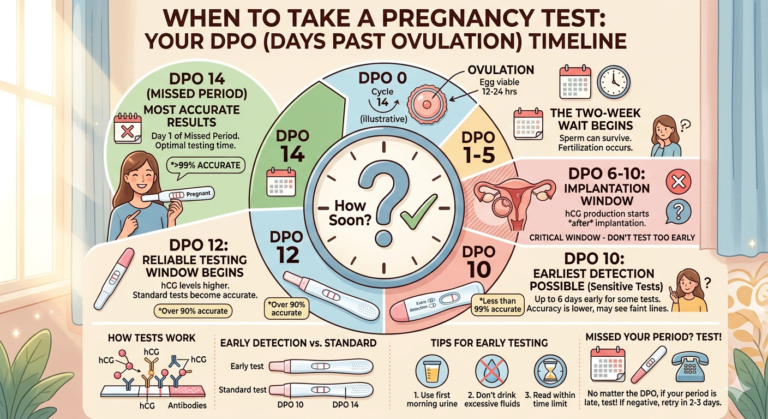
Most home pregnancy tests become reliably positive when hCG levels reach 20 to 25 mIU/mL. Some sensitive early detection tests can detect levels as low as 6 to 10 mIU/mL. A blood test can detect hCG at even lower levels — sometimes before a home test would be positive.
Can hCG levels be normal and still miscarry?
Yes — unfortunately a normal hCG level does not guarantee a viable pregnancy. Some miscarriages occur even when hCG levels are rising normally initially. This is why ultrasound evaluation alongside hCG monitoring gives a more complete picture of early pregnancy health.
How fast should hCG double?
In healthy early pregnancies hCG typically doubles every 48 to 72 hours up to approximately 6 weeks. After that the doubling time slows to every 72 to 96 hours. A doubling time slower than 48 to 72 hours warrants monitoring but does not automatically indicate a problem.
Does a faint positive pregnancy test mean low hCG?
Yes — the darkness of the line on a home pregnancy test roughly correlates with hCG concentration in the urine. A faint line means hCG is present but at a lower concentration — which may simply mean you are testing very early. Retesting 2 to 3 days later with first morning urine should show a darker line as hCG rises.
Can stress affect hCG levels?
There is no strong evidence that psychological stress directly affects hCG production — hCG is produced by the placental cells regardless of stress levels. However stress can affect other aspects of early pregnancy health and overall wellbeing. If you are anxious about your hCG results speak with your doctor who can provide context and appropriate monitoring.
What happens to hCG after 12 weeks?
After peaking around weeks 8 to 10 hCG levels gradually decline and plateau at a lower level for the remainder of pregnancy. This decline is entirely normal and is actually responsible for the improvement in first trimester symptoms — particularly nausea — that most women experience as they enter the second trimester.
The Bottom Line
hCG levels in early pregnancy are one of the most important indicators of how a pregnancy is developing — but they need to be interpreted in context rather than in isolation. The normal ranges at each week are extremely wide reflecting the enormous natural variation between individual pregnancies. What matters most is not the absolute number but whether your levels are rising at an appropriate rate over time.
Use our Free hCG Calculator to check your level against normal ranges for your week of pregnancy and to calculate your doubling time from two serial blood test results. Then bring any questions or concerns directly to your doctor who can interpret your specific results in the context of your full clinical picture.
Wondering how soon you could have first tested? See our guide on exactly how soon you can test after ovulation. And for a rundown of what else to expect, see our guide to early pregnancy symptoms before a missed period.
If you have not yet calculated your estimated due date use our Free Due Date Calculator — enter your last period date and find out when your baby is expected to arrive.
Medical Disclaimer: This article is for educational purposes only and does not constitute medical advice, diagnosis, or treatment. hCG levels should always be interpreted by a qualified healthcare provider in the context of your full clinical picture. Never use online tools as a substitute for medical evaluation. Read our full Medical Disclaimer.



2 Comments