
What Is a Fertile Window and How Do You Calculate Yours?
INTRO
What Is a Fertile Window Calculator? If you have ever searched for the best time to get pregnant, you have probably come across the term “fertile window.” But what exactly does it mean — and more importantly, how do you figure out when yours actually is? Understanding your fertile window is the single most important piece of knowledge for anyone trying to conceive. It is also one of the most misunderstood. In this article we are going to break it all down in plain English — what the fertile window is, how long it lasts, how to calculate it for your specific cycle, and what you can do right now to start identifying yours accurately.
What Is a Fertile Window?
Your fertile window is the stretch of days in your menstrual cycle when pregnancy is actually possible. It exists because of two biological facts that work together.
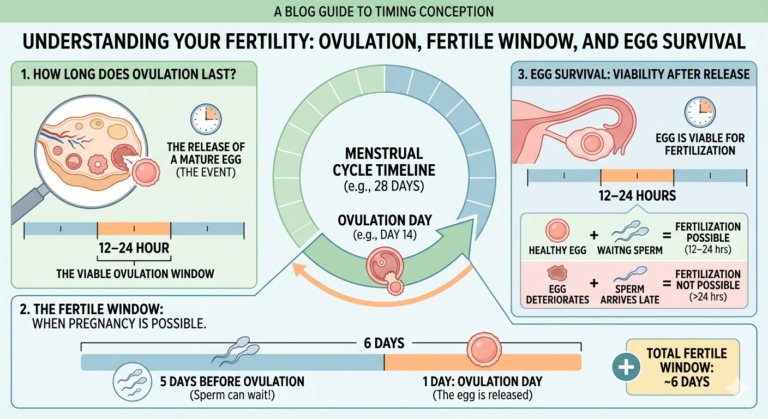
First — a human egg survives for only 12 to 24 hours after it is released during ovulation. After that window it dissolves and can no longer be fertilized.
Second — sperm can survive inside the female reproductive tract for up to 5 days under the right conditions, particularly when fertile cervical mucus is present to nourish and protect them.
Put those two facts together and you get a fertile window of approximately 6 days — the 5 days leading up to ovulation plus the day of ovulation itself. Pregnancy is possible on any of these 6 days, but your chances are highest in the 2 to 3 days immediately before and on the day of ovulation.
After ovulation the window closes. Once the egg has dissolved conception is not possible again until the next cycle.
Why Your Fertile Window Is Not the Same Every Month
Here is something many women do not realize — your fertile window shifts from cycle to cycle because ovulation does not happen on exactly the same day every month.
Even women with very regular cycles experience natural variation. A cycle that is usually 28 days might occasionally be 26 or 30 days. Stress, illness, changes in sleep, travel across time zones, significant changes in exercise or diet — all of these can push ovulation earlier or later than expected.
This is why relying on a fixed calendar date — for example always assuming you ovulate on day 14 — can lead you to miss your window entirely. Your fertile window needs to be calculated based on your actual cycle data, not a textbook average.
How to Calculate Your Fertile Window
There are two ways to calculate your fertile window — the formula method and the real-time tracking method. Using both together gives you the most accurate picture.
The Formula Method
This method uses your average cycle length to estimate when ovulation is likely to occur.
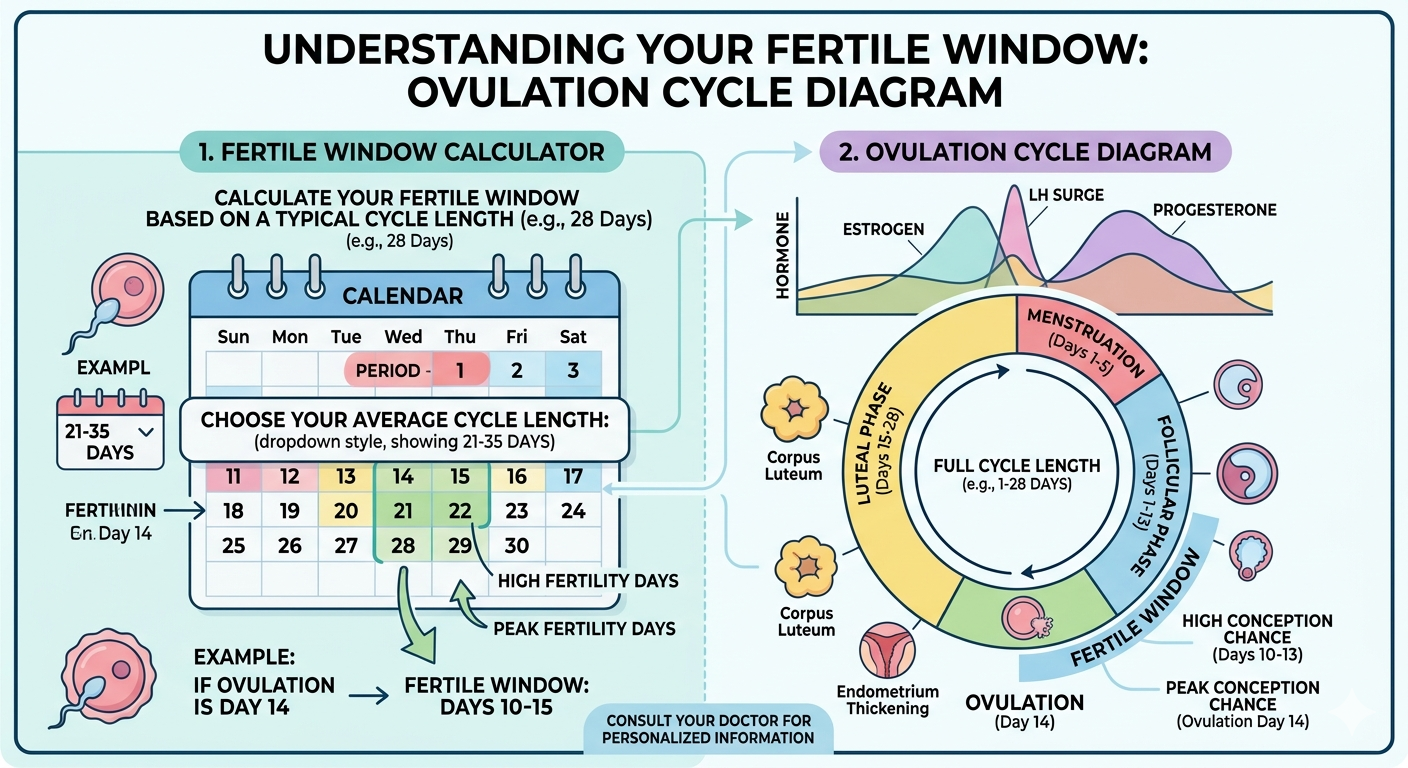
Step 1: Find the first day of your last menstrual period (LMP) — this is cycle day 1.
Step 2: Subtract 14 from your average cycle length. The result is your estimated ovulation day.
Example: if your cycle is 30 days long, your estimated ovulation day is day 16 (30 minus 14 equals 16).
Step 3: Your fertile window starts 5 days before ovulation and ends 1 day after. So in the example above, your fertile window would be cycle days 11 through 17.
You can skip all of this calculation and get your personalized fertile window instantly using our Free Ovulation Calculator — just enter your last period date and cycle length and your fertile window appears in seconds.
The Real-Time Tracking Method
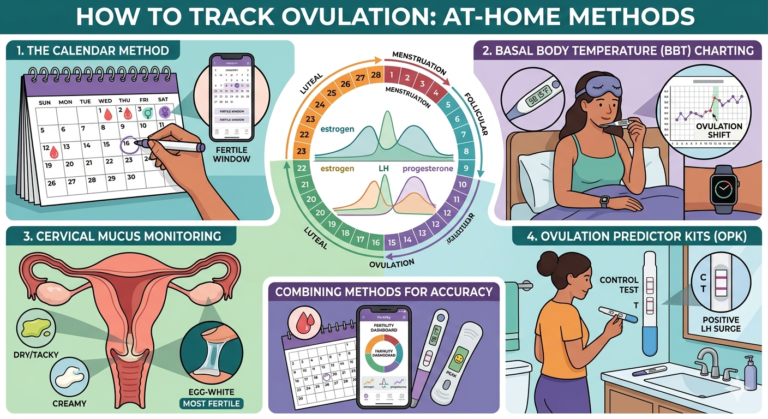
The formula method gives you an estimate — but the real-time tracking method tells you what is actually happening in your body right now. There are three main real-time signals to track:
Cervical mucus changes: In the days approaching ovulation your discharge becomes increasingly wet, clear, and stretchy — resembling raw egg whites. This egg-white cervical mucus (EWCM) is your most reliable real-time sign that ovulation is imminent.
LH surge on OPK tests: Ovulation predictor kits detect the surge of luteinizing hormone that triggers ovulation. A positive OPK means ovulation is typically 24 to 36 hours away — giving you advance notice to time intercourse.
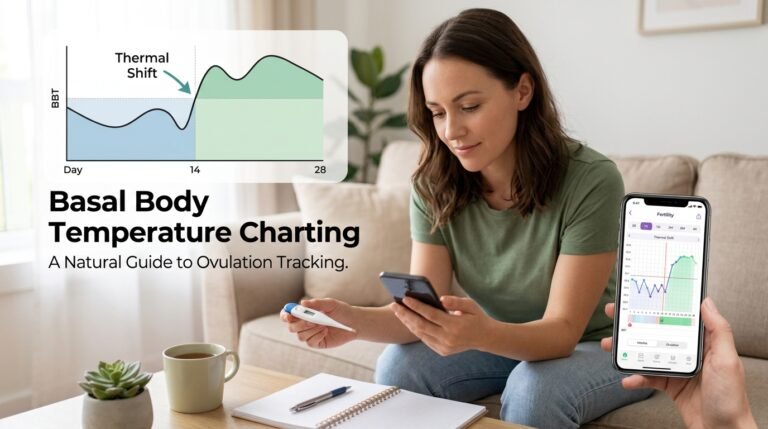
Basal body temperature rise: After ovulation your BBT rises slightly and stays elevated. This confirms ovulation has occurred but is most useful for identifying your pattern over several cycles rather than predicting ovulation in real time.
Fertile Window by Cycle Length — Quick Reference
Not sure when your fertile window falls? Here is a quick reference guide based on common cycle lengths. Remember these are estimates — real-time tracking gives you your exact personal window.
21-day cycle: Ovulation around day 7. Fertile window approximately days 2 to 8.
24-day cycle: Ovulation around day 10. Fertile window approximately days 5 to 11.
26-day cycle: Ovulation around day 12. Fertile window approximately days 7 to 13.
28-day cycle: Ovulation around day 14. Fertile window approximately days 9 to 15.
30-day cycle: Ovulation around day 16. Fertile window approximately days 11 to 17.
32-day cycle: Ovulation around day 18. Fertile window approximately days 13 to 19.
35-day cycle: Ovulation around day 21. Fertile window approximately days 16 to 22.
For a personalized calculation based on your exact cycle length use our Free Ovulation Calculator.
Your Most Fertile Days Within the Window
Not all 6 days in the fertile window are equal. Research published by the National Institutes of Health found that the probability of conception varies significantly depending on which day within the fertile window intercourse occurs.
Here is the breakdown of conception probability by day:
5 days before ovulation: approximately 10% chance of conception.
4 days before ovulation: approximately 16% chance.
3 days before ovulation: approximately 14% chance.
2 days before ovulation: approximately 27% to 33% chance — one of the peak days.
1 day before ovulation: approximately 31% chance — your highest probability day.
Day of ovulation: approximately 10% to 15% chance — lower than the day before because the egg is already released and beginning to deteriorate.
The key takeaway: the 2 days before ovulation are your absolute best days for conception. This is why identifying the LH surge with an OPK — which gives you 24 to 36 hours advance warning — is so valuable.
Signs Your Fertile Window Is Open Right Now
Your body gives you several signals when your fertile window is open. Look for these signs together for the clearest picture:
Egg-White Cervical Mucus
Clear, slippery, stretchy discharge that resembles raw egg whites is the most reliable physical sign that you are in your fertile window. The presence of this mucus means your body is creating a hospitable environment for sperm to survive and travel toward the egg.
Positive OPK Test
A positive ovulation predictor kit test — where the test line is as dark as or darker than the control line — means your LH has surged and ovulation is 24 to 36 hours away. This is your most actionable sign — time intercourse on the day of the positive test and the following day.
Mild Ovulation Pain
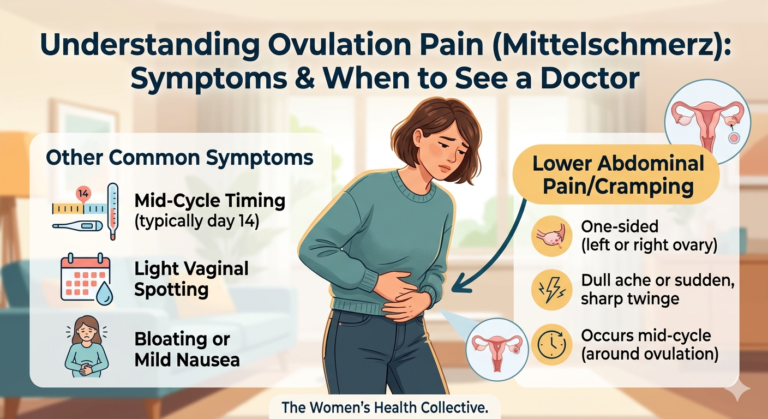
Some women feel a twinge or mild cramping on one side of their lower abdomen around ovulation — called mittelschmerz. While not everyone experiences this it can serve as a useful additional confirmation that your fertile window is open.
Increased Sex Drive
A natural rise in libido around ovulation is your body’s biological signal that your fertile window is open. If you notice this consistently mid-cycle it is worth paying attention to.
Spotting or Cramping During Your Fertile Window
Some women notice light spotting or mild cramping around the time of ovulation — and it can actually be a useful additional sign that you’re in your fertile window, alongside the signs above.
This spotting is caused by the natural drop in estrogen that happens right after ovulation, which can cause a small amount of the uterine lining to shed. It typically appears light pink or brown, lasts only a day or two, and is much lighter than a period. According to Cleveland Clinic, this affects around 5% of menstruating women and is generally considered normal.
Mild cramping around the same time is usually just mittelschmerz (see the section above) rather than anything related to the spotting itself.
When to check with a doctor: if spotting is heavy, lasts more than a couple of days, happens outside your usual mid-cycle timing, or comes with pain, odor, or other signs of infection, it’s worth getting checked rather than assuming it’s ovulation-related.
Common Mistakes That Cause Women to Miss Their Fertile Window
Even women who are actively trying to conceive often make a few key mistakes that cause them to miss their fertile window entirely.
Assuming Ovulation Always Happens on Day 14
Day 14 is the average for a 28-day cycle — but if your cycle is longer or shorter your ovulation day is different. And even with a 28-day cycle ovulation can shift by several days. Always base your estimate on your own cycle data rather than a textbook assumption.
Only Having Intercourse on Ovulation Day
Because the egg only survives 12 to 24 hours after release, having intercourse only on ovulation day actually gives you a lower chance of conception than having intercourse the day before ovulation. The sperm need to be waiting inside the fallopian tube before the egg arrives. Aim for the 2 days before your expected ovulation date.
Stopping Too Early
Some women stop having intercourse once they think their fertile window has passed. But because ovulation can be unpredictable it is wise to continue until 2 days after your expected ovulation date just in case ovulation was slightly delayed.
Relying on Apps Alone
Cycle tracking apps use the same formula method described above — they predict based on your average cycle length. They cannot actually detect ovulation. Combine app-based predictions with real-time tracking methods like OPKs and cervical mucus monitoring for significantly better accuracy.
What If You Cannot Find Your Fertile Window?
If you have been tracking your cycle for 3 or more months and still cannot identify a clear fertile window it may be worth speaking with your doctor. Some potential reasons include:
Irregular cycles — cycles that vary by more than 7 to 10 days each month make prediction difficult and may indicate an underlying hormonal issue worth investigating.
Anovulatory cycles — some cycles occur without ovulation, which is more common than many women realize. A day-21 progesterone blood test from your doctor can confirm whether ovulation is occurring.
PCOS — polycystic ovary syndrome can cause multiple LH surges that make OPK results confusing to interpret. If you suspect PCOS talk to your doctor for a proper evaluation.
You can also use our Free Period Tracker to log your cycles over time and look for patterns in your data.
Frequently Asked Questions
How many days is the fertile window?
The fertile window is approximately 6 days long — the 5 days before ovulation and the day of ovulation itself. However pregnancy is most likely in the 2 to 3 days immediately before ovulation.
Can I get pregnant outside my fertile window?
It is extremely unlikely. Pregnancy requires a live egg and live sperm to meet in the fallopian tube. Outside your fertile window the egg has either not yet been released or has already dissolved. The only exception is if your ovulation was significantly earlier or later than expected — which is why tracking rather than guessing is so important.
Does the fertile window change if my cycle is irregular?
Yes — with an irregular cycle your ovulation date and therefore your fertile window shifts from month to month. Real-time tracking methods like OPK tests and cervical mucus monitoring are especially important for women with irregular cycles since calendar-based predictions are unreliable.
How accurate is the fertile window calculator?
Our Free Ovulation Calculator uses the standard medical formula to estimate your fertile window. It is a reliable starting point but works best when combined with real-time tracking. The more cycle data you have the more accurate your estimate becomes.
What if I have a very short or very long cycle?
The formula works for any cycle length. A very short cycle (21 to 23 days) means ovulation happens early — sometimes as soon as day 7 or 8 — so your fertile window falls very close to your period. A very long cycle (35 days or more) means ovulation happens much later than average. In both cases real-time tracking is essential to catch your actual window.
Can stress delay my fertile window?
Yes. High stress levels can delay ovulation by several days or even suppress it entirely in some cycles. This is one of the most common reasons women miss their expected fertile window. If you are tracking your cycle and ovulation seems to be running late consider whether stress, illness, or major lifestyle changes might be contributing.
Does Plan B (emergency contraception) work during my fertile window?
Emergency contraception like Plan B can still work during your fertile window, but its effectiveness is time-sensitive and works best the sooner it’s taken after unprotected sex — effectiveness decreases the longer you wait, and it becomes less reliable if taken very close to or after ovulation has already occurred. If you’re relying on emergency contraception, taking it as soon as possible is the most important factor, and speaking with a pharmacist or doctor can help you understand your specific situation.
The Bottom Line
Your fertile window is the most important factor in conception — and understanding it puts you back in control of your reproductive health. The key points to remember are that your fertile window is approximately 6 days long, your 2 best days are the day before and the day of ovulation, and real-time tracking with OPKs and cervical mucus monitoring is far more accurate than relying on a calendar alone.
The best place to start is to calculate your estimated fertile window right now. Use our Free Ovulation Calculator — enter your last period date and average cycle length and your personalized fertile window appears instantly. It takes less than 30 seconds and gives you a clear starting point for tracking your cycle with confidence.
Medical Disclaimer: This article is for educational purposes only and does not constitute medical advice, diagnosis, or treatment. Always consult your doctor, OB-GYN, or qualified healthcare provider for personal health decisions. Read our full Medical Disclaimer.
3 Comments