Baby Development Milestones: What to Expect in the First Year
By Dr. Ayesha
Last updated: October 2026
Babies change quickly during their first year. A newborn who mostly sleeps, feeds, and looks at familiar faces gradually becomes a more active communicator and explorer. It is natural to wonder whether your baby is growing and learning as expected, especially when other parents share different timelines. This guide explains common baby development milestones from birth to 12 months, practical ways to support learning, and when it may be helpful to raise questions with your child’s healthcare provider.
Milestones are guideposts, not a pass-or-fail test. Children develop at different rates, and a baby may reach one skill early while taking more time with another. Use this article to support conversations with a qualified clinician—not to diagnose or compare your baby with another child.
What are baby development milestones?
Developmental milestones are skills many children can do by a certain age. They are generally grouped into areas such as social and emotional development, communication, thinking and learning, and movement. For example, a baby may begin smiling at people, making sounds, reaching for a toy, or sitting with less support as they grow.
Milestone ages describe broad patterns across groups of children. They do not predict the exact date an individual baby will acquire a skill. A child’s development is influenced by many factors, including health, opportunity to practice, temperament, and whether they were born early. If something concerns you, it is reasonable to ask a healthcare provider—even if your baby has not reached a particular age on a checklist.
It also helps to distinguish development from physical growth. Growth charts track measurements such as weight, length, and head circumference over time. Developmental milestones describe skills and behavior. You can explore growth measurements with our Baby Percentile Calculator, but a percentile is not a measure of intelligence or developmental ability. Your clinician can interpret growth patterns alongside your baby’s health and history.
Baby milestones from birth to 3 months
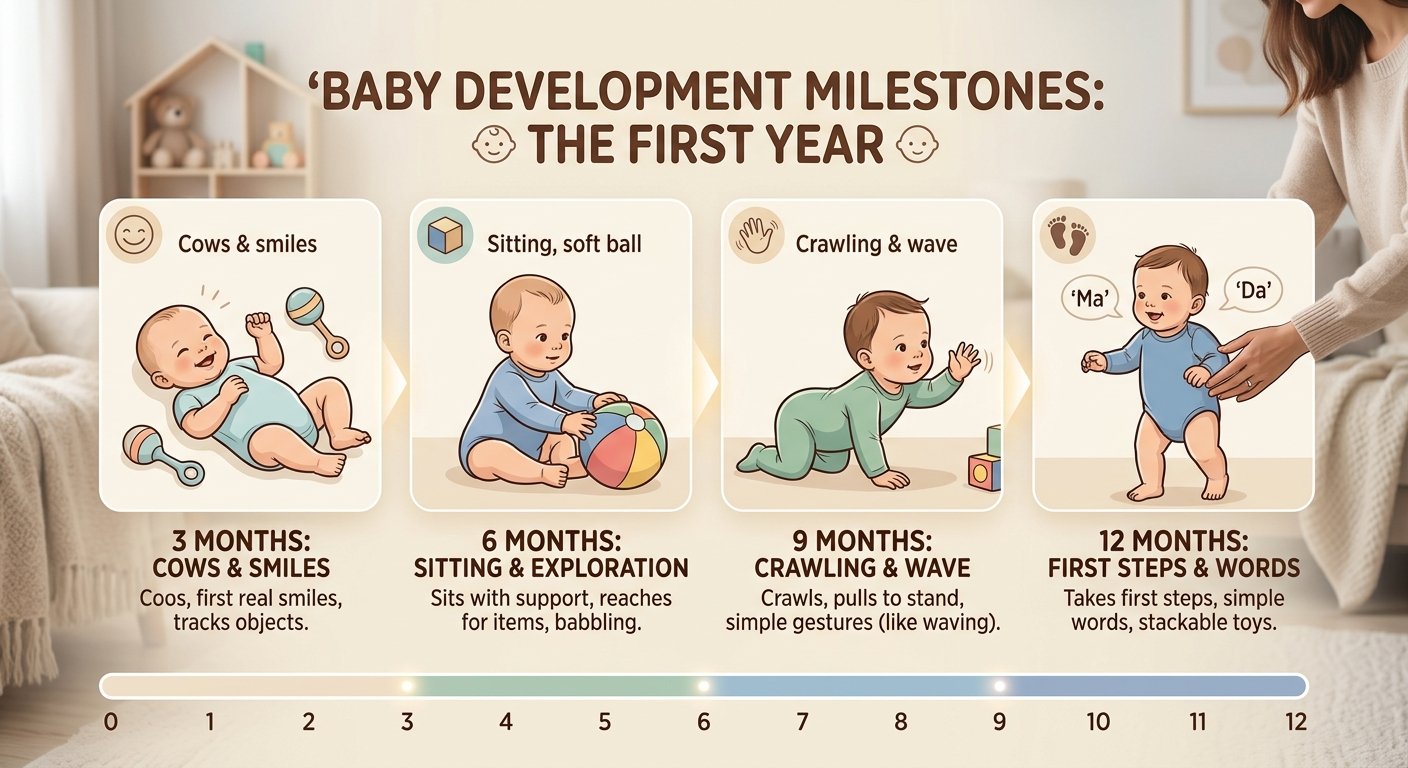
In the first three months, babies are learning to respond to the people and environment around them. Many look at a caregiver’s face, react to familiar voices, calm when held or spoken to, and make sounds beyond crying. Some begin to follow a moving person or object briefly with their eyes. During supervised awake time, many babies start lifting their head for short periods while on their tummy, although head control is still developing.
Newborn movements may look uncoordinated. Babies are still gaining control of their neck, arms, and hands. They may start bringing a hand toward the mouth or briefly hold an adult’s finger. These early actions do not need to be taught through formal lessons; responsive care and safe opportunities to interact are valuable.
Talk, sing, smile, and respond when your baby makes sounds. Pause after speaking so your baby has time to respond with a look, movement, or sound. During awake periods, supervised tummy time can give babies a chance to practice head and shoulder movement. Follow current safe-sleep guidance: place babies on their backs for every sleep, on a firm, flat surface, and keep pillows, loose bedding, and soft objects out of the sleep space. Ask your child’s clinician if you need help adapting tummy time or positioning for your baby.
Baby milestones from 4 to 6 months
Between four and six months, many babies become more expressive and interested in people and objects. They may smile to get attention, chuckle, make sounds back and forth with an adult, turn toward a familiar voice, or reach for a toy. Some push up on their arms during tummy time, bring objects to their mouth, or begin rolling in one direction. Skills can appear gradually, and babies may need repeated opportunities to practice.
Give your baby safe objects to look at and reach for, and stay close during floor play. Choose toys that are age-appropriate, too large to swallow, and free of detachable small parts. Keep cords, plastic bags, hot drinks, and other hazards away from the play area. If your baby begins rolling, ask your healthcare provider about safe sleep and make sure the sleep surface remains clear.
Around this age, families may have questions about starting solid foods. Readiness and recommendations vary by child and country. Breast milk or infant formula remains an important source of nutrition during infancy. Ask your baby’s clinician when to introduce complementary foods and how to do it safely, including how to reduce choking risks. Do not use a general online article as a substitute for individualized feeding guidance.
Baby milestones from 7 to 9 months
Many babies in this stage respond to their name, babble repeated sounds, enjoy interactive games, and show curiosity about objects. Some pass an object from one hand to another, sit without support, or move around by rolling, scooting, crawling, or another method. Not every baby crawls on hands and knees, and the timing of sitting and mobility varies.
You can support communication by naming familiar people and objects, reading picture books, singing, and responding to your baby’s babbling. Play simple turn-taking games such as peekaboo if your baby enjoys them. Give your child a safe area to explore while supervised. As mobility increases, secure furniture that could tip, use safety gates where needed, cover or block access to hazards, and keep small objects and medicines out of reach.
Babies learn by exploring, but they also need rest and calm interaction. Follow your baby’s cues: look away, fussing, or turning their body can mean they need a break. A supportive routine does not have to be rigid; it can simply include regular chances to play, connect, feed, and sleep.
Baby milestones from 10 to 12 months
Toward the end of the first year, many babies use gestures such as waving, play simple interactive games, respond to familiar words, and babble with varied sounds. Some pick up small pieces of food between their fingers, pull to stand while holding furniture, or move along furniture while holding on. A few take independent steps around this time; many healthy children begin walking later.
Continue talking, reading, singing, and responding to your baby’s attempts to communicate. Describe everyday activities and name objects your baby is looking at. Offer safe opportunities to move and play, but avoid pressuring your child to perform a skill for visitors or a camera. If your baby was born prematurely, ask their clinician whether corrected age is relevant when discussing development; the right approach depends on the child and local clinical guidance.
How to support your baby’s development every day
There is no need for expensive equipment or a packed activity schedule to support early learning. Everyday interactions provide many opportunities for babies to practice communication, movement, attention, and connection.
Respond to your baby’s sounds and expressions. When they look at something, name it; when they babble, answer as if you are having a conversation. Read or tell stories, sing, and share face-to-face play. Provide supervised floor time and safe objects appropriate for your baby’s age. Let your child have time to explore at their own pace, while staying close enough to prevent injury.
Keep routine health visits and bring questions, observations, or short notes about what you have noticed. If useful, write down when a skill first appeared, what your baby can do now, and whether a skill seems to have changed. A clinician can consider the full picture—including health history, hearing, vision, feeding, and opportunities to practice—rather than making a judgment from one checklist item.
Growth and developmental skills are different, but both are useful topics at well-child visits. Our Baby Percentile Calculator is an educational tool for exploring growth measurements; use your child’s clinician’s guidance when interpreting them. You may also find the Pregnancy Appointment Timeline useful during pregnancy as you prepare for prenatal visits and discuss newborn care planning with your provider.
When should I talk with a healthcare provider?
Contact your child’s healthcare provider if you have concerns about development, if your baby loses a skill they previously had, or if you notice a persistent difficulty with hearing, seeing, feeding, movement, or interaction. You do not need to wait for a scheduled appointment to bring up a concern. Ask whether developmental screening is appropriate and what next steps are available. If your baby appears acutely unwell or has an urgent health problem, seek local urgent or emergency care.
Developmental screening is different from a milestone checklist. A screening tool is a more formal process used by a healthcare professional to identify whether further evaluation may be helpful. It does not by itself diagnose a condition. Your clinician can explain screening options and refer you to appropriate local services if needed.
The CDC’s Learn the Signs. Act Early. milestone resources provide age-based checklists and guidance on discussing concerns. These resources are developed for the United States; families elsewhere should follow their local health authority’s recommendations. The American Academy of Pediatrics’ developmental surveillance and screening overview also explains how developmental monitoring can be part of routine pediatric care.
Frequently asked questions about first-year development
Do all babies reach milestones at the same age?
No. Milestones describe common developmental patterns, not a fixed timetable for every child. Babies develop at different rates and may acquire skills in a different order. If you are concerned about your baby’s progress, discuss what you observe with their healthcare provider.
Should I worry if my baby is not crawling by 9 months?
Not necessarily. Some babies crawl in different ways, and some do not crawl in the familiar hands-and-knees style. Consider your baby’s overall development and ask their clinician if you are concerned, particularly if your baby has lost a skill they previously had.
Are growth percentiles developmental milestones?
No. Percentiles compare a child’s measurements with a reference population. Developmental milestones describe skills such as communicating, moving, and interacting. Both can inform conversations at health visits, but neither alone provides a complete picture of a child’s health.
What if my baby was born prematurely?
Premature babies may be assessed using corrected age for some developmental milestones during early childhood. Whether and how to use corrected age depends on the child’s circumstances and clinical guidance. Ask your baby’s healthcare provider how to interpret milestones for your child.
Can I help my baby reach milestones faster?
There is no need to rush development or train a baby to meet a milestone by a particular date. Responsive interaction, safe play, reading, talking, and routine healthcare visits support learning. If you have concerns, a clinician can suggest activities or services suited to your baby.
What should I bring up at a well-child visit?
Share what your baby enjoys, what skills you have noticed, and any changes that concern you. Mention questions about movement, sounds, response to voices, vision, feeding, sleep, or social interaction. If a skill was lost, explain when you noticed the change. Notes or short videos may help describe what you observe, but follow your clinician’s advice about what to share.
A reassuring note for parents and caregivers
It is understandable to compare timelines, but a single milestone or percentile cannot tell the whole story. Your baby is an individual, and development unfolds over time. Keep offering safe, responsive interaction, attend routine health visits, and raise questions when they arise. If you are worried, asking a qualified professional is a sensible next step—not a sign that something is necessarily wrong.
Author: Dr. Ayesha
Medical review: Not stated; add this label only after a qualified clinician has reviewed and approved the article.
Last updated: October 2026
Medical information notice: This article is for general educational purposes and is not a substitute for individualized medical advice, diagnosis, or treatment. Milestones vary, and this article cannot assess an individual child. Contact your child’s healthcare provider with questions or concerns.
References